

Claim Climbers publishes more pricing than many companies in the paid VA medical-evidence market. Its current offer starts with a $195 medical-record review, then moves to nexus letters advertised at $600 to $795 each. That makes the company easier to evaluate than a vendor that hides every number behind a sales call. It does not make the decision automatic.
The real questions are whether you need private medical evidence at all, which clinician will review your file, whether that clinician's qualifications fit your condition, what the finished opinion will actually address, and what happens if VA finds the opinion unpersuasive. A polished letter is not valuable merely because it is long or uses the phrase "at least as likely as not." The reasoning and the fit between the author and the medical issue matter.
I built Claim Raven, which competes for some of the same veterans' attention, so this is not a neutral consumer-magazine review. Claim Raven provides self-directed claim organization and evidence tools. It does not sell nexus letters and it does not decide whether Claim Climbers' clinicians are qualified. This review is based on public sources checked August 27, 2026. I did not purchase the service, inspect a completed client file, or independently audit the company's security systems. Pricing, personnel, and contract terms can change, so get the current agreement and clinician information before paying.
TL;DR
- Claim Climbers is a paid medical-evidence company, not a law firm, Veterans Service Organization, accredited claims agent, or VA representative.
- Its advertised process starts with a $195 medical-record review. Nexus letters are listed at $600 to $795 per letter, with possible discounts for multiple letters.
- A simple advertised one-letter path therefore costs $795 to $990: $195 for the review plus $600 to $795 for one letter. That is an illustration, not a guaranteed quote.
- The company advertises a refund of the $195 review fee if its review finds no conditions it believes could support a nexus letter. That is a screening refund, not a promise that VA will grant the claim.
- Claim Climbers says it will review a denial and may provide a response or more evidence without another charge when the records support doing so. Its terms also say completed services are not refundable. Get the exact boundaries in writing.
- The site says work is overseen by physicians or physician assistants, but it does not publish a complete clinician roster with names, state licenses, specialties, and who signs each type of opinion.
- Its privacy policy says it may collect Social Security numbers, medical records, health information, attachments, and recorded calls. It names several storage and analytics providers, but does not publish a fixed retention period.
- This may fit a veteran who has a defined medical-evidence gap and is comfortable filing independently. It does not replace an accredited representative, legal advice, treatment, or a VA claim exam.
What Claim Climbers actually sells
Claim Climbers describes a staged evidence service. First, it reviews the veteran's medical records. The result is what the company calls a Nexus Eligibility List, which identifies conditions it believes the records could support. The veteran can then buy one or more nexus letters.
That distinction matters. The $195 review is not itself a nexus letter. It is a paid screening step. The company can tell a veteran that the records appear to support an opinion, but VA still evaluates the eventual opinion, the underlying records, the clinician's reasoning, and the rest of the claim.
The company's services and pricing page advertises:
- a $195 medical-record review;
- a condition-by-condition eligibility list;
- nexus letters priced from $600 to $795 each;
- discounts when multiple letters are ordered;
- delivery in roughly seven to ten business days; and
- a review of a later denial with a possible no-cost response when the records support one.
Its terms draw a useful boundary. Claim Climbers says it develops medical evidence, does not represent veterans before VA, and is not a substitute for an accredited representative or legal counsel. The veteran remains responsible for deciding what to file and for submitting the evidence.
Full Claim Climbers price math
The most useful way to read the price is as a sequence, not as a single headline number.
| Example purchase | Advertised math | Illustrative total |
|---|---|---|
| Records review only | $195 | $195 |
| Review plus one $600 letter | $195 + $600 | $795 |
| Review plus one $795 letter | $195 + $795 | $990 |
| Review plus two letters before any discount | $195 + $1,200 to $1,590 | $1,395 to $1,785 |
The company mentions multi-letter discounts, so the two-letter row is not necessarily what a real customer will pay. It is the undiscounted math using the public range. Ask for an itemized quote stating the review fee, the price of each letter, any examination charge, rush fee, revision fee, financing cost, and taxes before authorizing work.
Claim Climbers also advertises Klarna, Affirm, and Afterpay. Financing changes when the money leaves your account, not what the service is worth. The final cost can depend on the financing provider's terms, eligibility decision, interest or other charges, and late-payment rules. Compare the financed total, not just the installment size.
Start with a free claim assessment. Answer a few quick questions and review one claim document to see what the record supports, what may be missing, and what to check next. Start my Free Claim Readiness Review. A free account and separate AI consent are required before uploading. No credit card is required; optional deeper tools have their own limits. This educational review does not predict a rating or replace an accredited representative.
Claim Raven works alongside your accredited representative. It never replaces one. We never take a percentage of your back pay. Plans are a flat monthly price you can cancel any time from your billing page. We never contact VA about your claim and never file anything on your behalf.
What the $195 records review does and does not prove
A records review can be useful when a veteran has hundreds or thousands of pages and is unsure whether the file contains a plausible medical link. It can also prevent someone from paying for a full opinion when the records do not support one.
But the company's decision that a condition is "eligible" is not a VA finding. It does not establish service connection. It does not show that the eventual clinician will agree. It does not fix missing service records, a weak diagnosis, an inaccurate factual history, or a medical question outside the assigned clinician's expertise.
Before ordering a letter, ask Claim Climbers to state:
- the exact question the clinician will answer;
- the records and lay statements the clinician will review;
- the clinician's name, profession, specialty, and active license state;
- whether an interview or examination is included;
- whether medical literature will be cited when appropriate;
- how factual errors and omitted records are corrected; and
- whether the clinician can explain or defend the opinion if VA challenges it.
Those answers reveal more than a generic sample letter.
How VA treats a private nexus letter
VA can consider private medical evidence, including an independent medical opinion. It is not required to accept a private opinion merely because a veteran paid for it.
The persuasive value usually turns on whether the author was qualified for the issue, knew the relevant history, used accurate facts, addressed competing evidence, and explained the reasoning connecting the medical facts to the conclusion. A conclusion without a reasoned explanation can be discounted. An opinion based on an inaccurate history can fail even when the correct legal phrase appears in the final paragraph.
For public Disability Benefits Questionnaires, VA says veterans may submit forms completed by their health-care providers, VA does not reimburse the cost, and VA may still require another examination. The same practical warning belongs beside any paid evidence purchase: the invoice buys a private service, not a VA outcome and not an exemption from a later C&P exam.
Refund and rebuttal language
Claim Climbers' public refund language is narrower than a money-back guarantee for the whole claim.
The company says it will refund the medical-record review if the review identifies no condition that it believes could be supported with a nexus letter. That can reduce the cost of an unsuccessful screening. It does not promise a refund because a clinician declines to write a favorable opinion later, because VA schedules another exam, or because VA denies the claim.
The company also says it offers a free denial review and, when the records support it, a response or rebuttal with additional evidence at no extra charge. The conditional phrase matters. Not every denial can be answered by another letter, and a disagreement about law, effective date, procedure, or credibility may require a different kind of help.
Meanwhile, the public terms say services are not refundable after they have been provided. Before paying, ask for a written answer to four scenarios:
- What happens if the reviewer identifies a condition but the assigned clinician will not write a favorable opinion?
- What happens if the letter contains a factual error?
- How many revisions are included, and for how long?
- What exactly triggers the advertised no-cost denial response?
Treat any verbal answer as incomplete until it appears in the order form or service agreement.
Claim Climbers accreditation and representation
Claim Climbers' own terms say it does not represent veterans before VA. An exact-name search of VA's recognized-organization directory did not return a Veterans Service Organization named Claim Climbers on the date of this review. That result should not be stretched into a claim about every employee or every clinician. VA accredits individual attorneys and claims agents and recognizes VSOs; states license medical professionals. Those are different systems.
If you want someone to prepare, present, or prosecute the claim as your representative, use VA's accreditation search and appointment guidance. VA says accredited VSO representatives provide claim help free, while accredited attorneys and claims agents can charge in permitted circumstances after an initial decision.
Buying a medical opinion is a different transaction. A clinician can provide medical evidence without becoming the veteran's representative. The practical problem arises when the scope is vague. Be clear whether you are buying a medical document, claim strategy, form preparation, filing assistance, or representation. Claim Climbers publicly describes the first category.
Who writes the opinion
Claim Climbers says its work is overseen by certified physicians or physician assistants. The public pages do not provide a complete roster that lets a buyer match every name, license, specialty, and service type before paying.
That does not prove the clinicians are unqualified. It means the buyer still has diligence to do. Ask for the proposed signer's information before the order becomes nonrefundable, then verify the license directly with the relevant state licensing board. Confirm that the license is active, that the profession can perform the evaluation involved, and that the clinician has relevant experience for the condition.
For a complex question, specialty fit can matter. An orthopedic issue, sleep disorder, psychiatric condition, neurologic disease, and toxic-exposure cancer do not present the same medical question. "Medical professional" is too broad to evaluate the fit.
Also ask whether the author personally reviews the complete file and forms the conclusion. Administrative staff can organize records. The medical opinion must remain the clinician's independent work.
Privacy and medical-record handling
This service involves more than an email address and payment card. Claim Climbers' privacy policy says the company may collect Social Security numbers, protected health information, medical records, attachments, communications, and call or video recordings.
The policy names Google Cloud, Amazon Web Services, SiteGround, and Dropbox among storage providers and says Stripe handles payment processing. It also discusses analytics or advertising tools associated with Google, Meta, and LinkedIn. Naming vendors provides more detail than a one-line "we value privacy" notice, but it is not an independent security audit.
The public policy does not give every veteran a simple fixed deletion date. Ask:
- which system will receive your records;
- which staff and clinicians can access them;
- whether subcontractors sign appropriate health-data agreements;
- whether email or text will be used for sensitive documents;
- how long the company and clinician retain the file;
- how to request access, correction, or deletion; and
- what survives in backups after an account is closed.
The terms warn that ordinary email and SMS are not encrypted. Do not send a C-file, DD214, Social Security number, or full medical history through an unapproved channel simply because a message asks for it.
Claim Climbers reviews and complaints
Public reviews can show recurring service themes. They cannot establish a medical success rate.
On August 27, 2026, Claim Climbers' BBB pages displayed an accredited business profile, an A+ rating, and a customer-review average in the mid-four-star range. Its complaints page showed one complaint in the displayed three-year period and marked it resolved. BBB also warns that it does not verify the accuracy of every customer submission. Its letter grade reflects BBB's own profile factors, not VA outcomes or clinical quality.
A Reddit discussion contains mixed anecdotes. Some posters describe favorable experiences or useful letters; others question price, provider fit, communication, or results. Those accounts are not files we can audit. A veteran can receive a well-written private opinion and still lose for an unrelated reason. Another can win after submitting several pieces of evidence, making it impossible to isolate what the purchased letter did.
Focused searches of FTC, VA, DOJ, Washington attorney-general material, and exact-name federal court opinions did not identify a company-specific enforcement action in this research pass. That is a bounded search result, not proof that no dispute, complaint, or lawsuit exists.
The useful review question is not "Did strangers win?" It is "Will the contract, clinician, records reviewed, medical reasoning, correction process, and data handling meet my needs?"
Who Claim Climbers may fit
Claim Climbers may be worth evaluating if:
- you already understand the claim you plan to file;
- the missing piece is a defined medical nexus question;
- you want a paid screening before ordering a full opinion;
- you are comfortable submitting the evidence yourself;
- you can verify the assigned clinician before work starts; and
- the written refund and revision terms match your risk tolerance.
It may be a poor fit if:
- you need a representative to communicate with VA;
- you need legal analysis of an appeal or effective-date dispute;
- you need diagnosis, treatment, or emergency medical advice;
- you expect a purchased letter to guarantee a rating;
- you cannot obtain the signer's credentials before paying; or
- you are uncomfortable sending medical records under the stated privacy terms.
Alternatives to Claim Climbers
Start with the least expensive path that can answer the real question.
- Your treating provider. A clinician who knows your history may be able to document diagnosis, severity, or causation. Ask whether the clinician is comfortable with VA's evidentiary question. VA does not reimburse private DBQ costs.
- A free accredited VSO representative. A VSO can help identify whether the file truly needs private medical evidence and can help prepare or submit a claim at no charge.
- A VA-accredited attorney or claims agent after a decision. For a denial involving legal or procedural issues, accredited representation may be more useful than buying another medical letter.
- Another independent medical-evidence vendor. Compare the full price, named clinician, specialty, examination model, refund trigger, revision policy, and retention schedule. Do not compare only the starting price.
- Self-organization tools. If the bottleneck is understanding and organizing the file rather than obtaining a new medical opinion, a software tool may be the more proportionate purchase.
For a broader price and service comparison, see Claim Raven's nexus-letter company cost guide and the independent REE Medical review.
Claim Climbers vs Claim Raven
Claim Climbers and Claim Raven are not substitutes for the same service.
Claim Climbers sells human medical-record review and private nexus opinions. Claim Raven provides software that helps a veteran organize evidence, understand claim requirements, and work through a self-directed claim. Claim Raven does not sell a nexus opinion, select a clinician, or place a medical signature on evidence.
Claim Raven's paid software plans currently range from $14.99 to $39.99, while the optional Pathfinder service is $500 for 365 days, paid once or as $200 today and five monthly payments of $60. A Claim Climbers one-letter path is advertised at $795 to $990 before any financing cost. The price gap reflects a different product, not proof that one is better.
If you need a clinician's independent medical opinion, Claim Raven cannot replace it. If you already have adequate medical evidence and mainly need organization, paying for another opinion may be unnecessary. A veteran can also use software for organization and separately hire a clinician, but each purchase should solve a specific gap.
Questions to ask before paying Claim Climbers
- What is my exact all-in price, including the $195 review and every letter?
- What does the review deliver if I do not buy a letter?
- Who will sign my opinion, and what are their license number, state, and specialty?
- Will the signer review my entire C-file, service records, lay evidence, and unfavorable exams?
- Is an interview or examination included?
- What happens if the clinician cannot support the requested conclusion?
- What is refundable after the review, after assignment, and after drafting begins?
- How many factual corrections or substantive revisions are included?
- What exactly qualifies for the no-cost denial review or response?
- How are my records transferred, stored, shared, retained, and deleted?
- Will any sensitive information be sent through ordinary email or text?
- Who helps if the denial is legal or procedural rather than medical?
Bottom line
Claim Climbers has a comparatively understandable public buying path: pay $195 for a records review, then $600 to $795 per nexus letter if you proceed. The screening refund and conditional denial-response language are meaningful features, but neither is a VA-outcome guarantee.
The purchase decision should turn on the assigned clinician, the question the opinion will answer, the records reviewed, the full written price, the refund and revision boundaries, and the medical-record workflow. Get those facts before the service becomes nonrefundable. If the real problem is representation, treatment, or a legal appeal issue, use the professional built for that problem instead.
Public feedback: positive experiences, concerns, and limits
Feedback checked September 10, 2026. This update covers outside feedback; it does not redate every price or legal source elsewhere in the article.
What reviewers liked
The author of this Claim Climbers discussion later reports being pleased with the purchase. Another customer praises the speed and writing of the delivered letters. Those are positive reports about the service experience.
What reviewers disliked or what remains unverified
That second customer's later updates describe disappointing VA results and subsequent rebuttal help without another fee. The early praise and later disappointment belong to the same person's account. Company-account comments and unrelated referral promotions in the thread are not independent customer endorsements.
What I would check before paying
Ask which corrections or rebuttals are included and how the clinician addresses conflicting evidence. Fast delivery and polished writing do not guarantee a favorable decision. The later support described by a customer is useful context, but verify that the current agreement promises it for your purchase.
How I checked: Exact-brand Reddit and open-web review searches; selected linked material, not an exhaustive platform export. Purchases and claim outcomes were not independently verified. These accounts cannot establish a success rate or predict your result.
Sources and limitations
Sources checked August 27, 2026 include Claim Climbers' services and pricing, how it works, terms, privacy policy, management page, and BBB profile. Regulatory context comes from VA's public DBQ guidance and accredited-representative guide.
Company claims about turnaround, clinician oversight, discounts, privacy controls, and customer outcomes were not independently audited. BBB and forum material are limited, user-submitted context. This review does not decide whether a particular medical opinion is adequate and is not legal or medical advice. Before you pay, confirm the current price, personnel, terms, complaint record, privacy policy, and regulatory status.
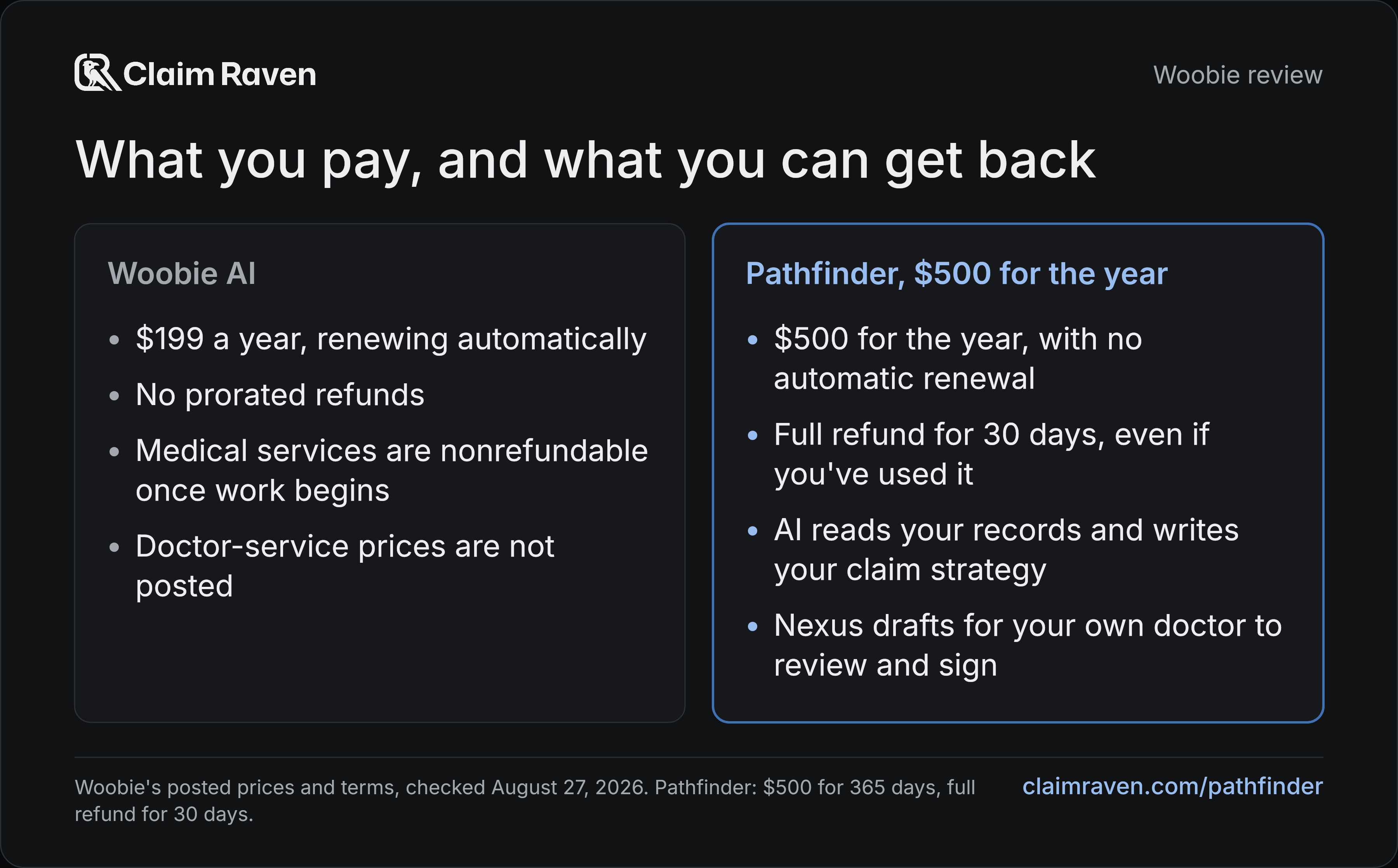 Woobie Review: AI Pricing, Medical Services, and Refunds
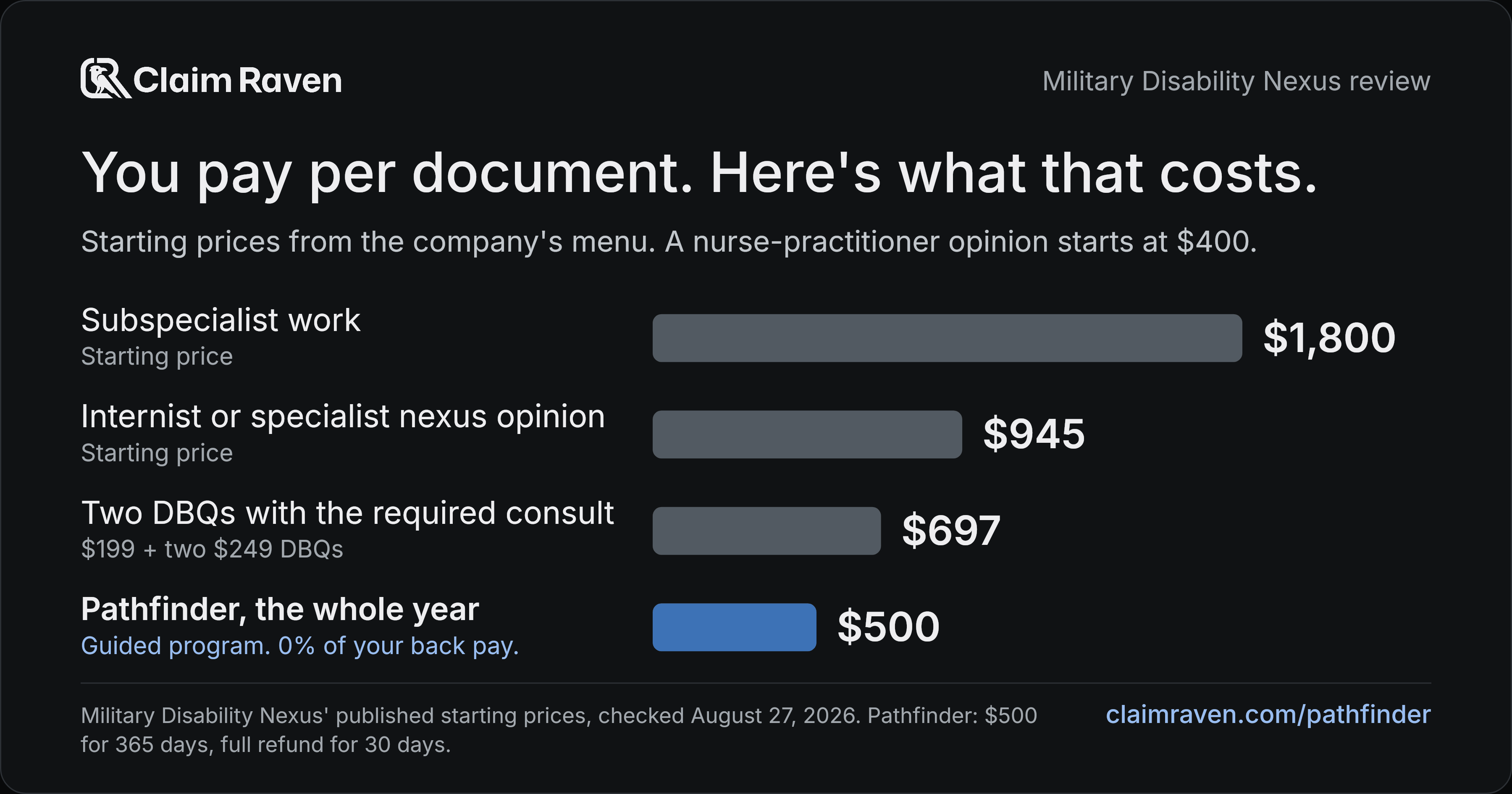 Military Disability Nexus Review: Prices, DBQ Math, and Fine Print
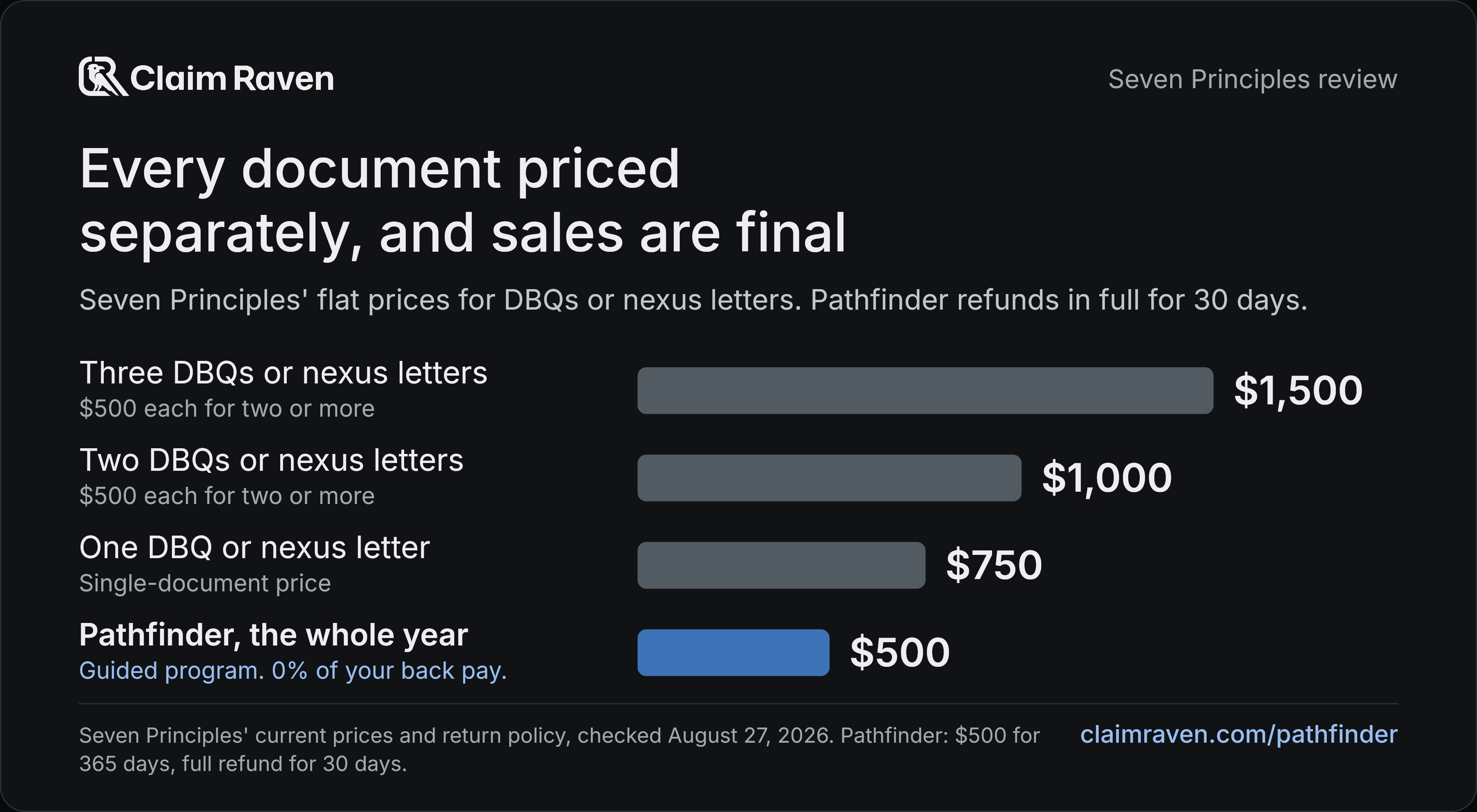 Seven Principles Review: Current DBQ Prices and Old Fee Pages