

The VA appeals process does not follow one automatic ladder. In the modernized system, you choose an available review option based on the decision you received and whether you need to add evidence. You do not have to complete Higher-Level Review before asking for a Board Appeal.
This flow chart covers ordinary, non-contested disability compensation decisions in the modernized system. Read your decision notice first. Legacy appeals, contested claims, and appeals to the Court have separate rules.
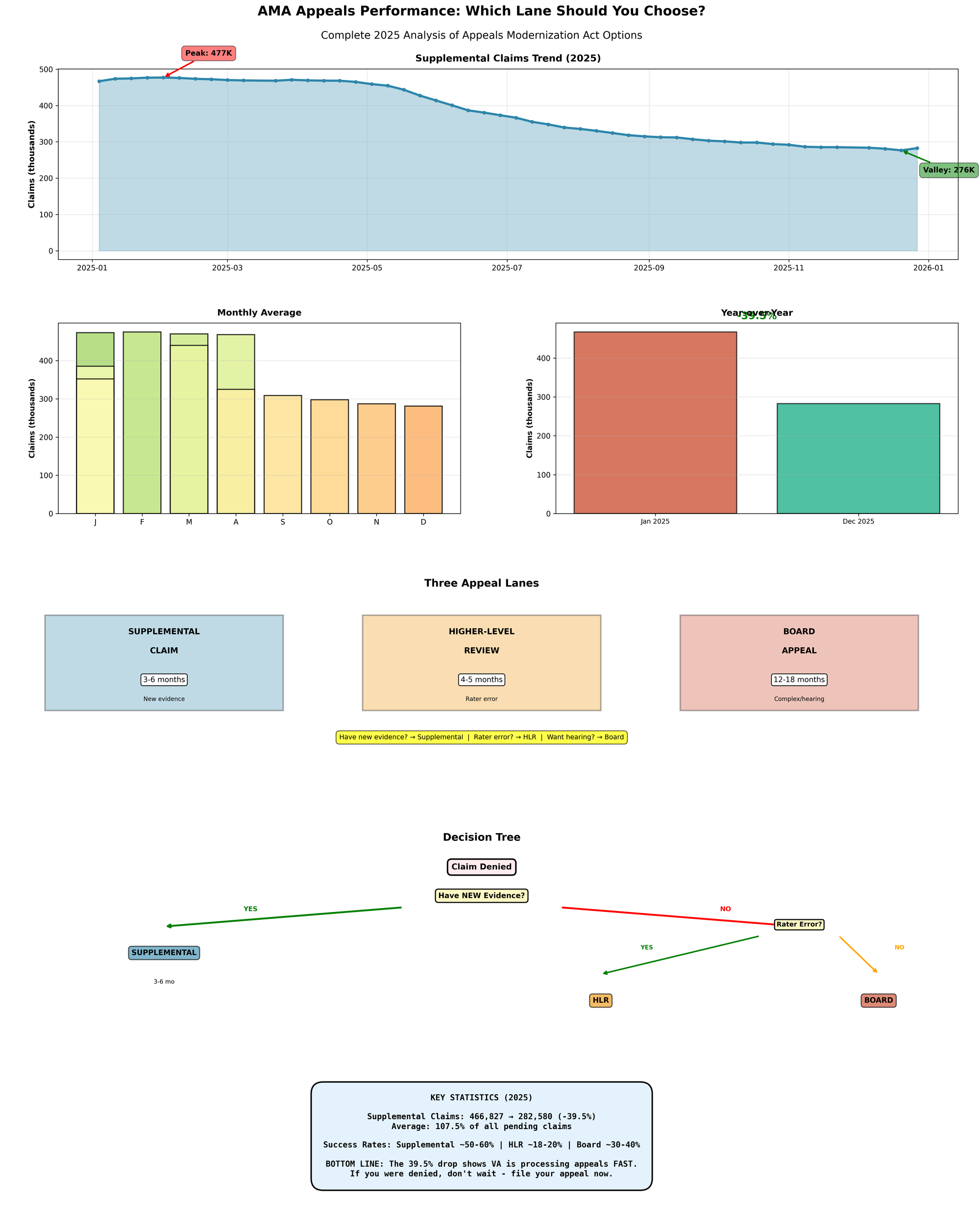
VA appeals process flow chart
| Start here | Available next paths to check |
|---|---|
| Initial disability compensation decision | Supplemental Claim; Higher-Level Review; Board Appeal |
| Supplemental Claim decision | Another Supplemental Claim with new and relevant evidence; Higher-Level Review; Board Appeal |
| Higher-Level Review decision | Supplemental Claim; Board Appeal. You cannot request HLR of that HLR decision on the same issue |
| Board decision denying an issue | Supplemental Claim; appeal to the U.S. Court of Appeals for Veterans Claims. HLR is not an option for a Board decision |
| Board remands an issue | VA completes the ordered development. In modernized review, VA issues a new decision; the issue does not automatically return to the Board |
Read the current VA decision review options for the path that matches your starting point. “Available” does not mean every option will meet your evidence needs or that every deadline is still open.
Choose the branch by the problem you need to address
Do you need VA to consider new evidence? Look at a Supplemental Claim, or a Board docket with an applicable evidence window. A Supplemental Claim generally requires new and relevant evidence; VA also describes requests based on a qualifying change in law.
Do you believe the decision misread evidence already in the file or made another error on the existing record? Higher-Level Review may fit if it is available for that decision and timely. It accepts no new evidence. The optional informal conference lets you identify errors; it does not create a new-evidence window.
Do you want a Veterans Law Judge to review the issue? Consider a Board Appeal and select the docket deliberately. Direct Review has no new evidence or hearing. Evidence Submission permits evidence with the request or within 90 days after VA receives it. Hearing permits evidence at the hearing or within 90 days afterward.
For a fuller comparison with fictional examples, use Supplemental Claim vs. HLR vs. Board Appeal.
Add the deadline before following an arrow
For an initial, Supplemental, or HLR decision, an HLR or Board request generally must be filed within one year, subject to the rules about which reviews are available. A Supplemental Claim can generally be filed later, but delay can affect the effective date and potential back pay.
After a Board denial, the Court appeal deadline is 120 days from the decision date, and the appeal is filed with the Court. The fact that another issue was remanded does not mean you can ignore the deadline for a denied issue.
These deadlines are not interchangeable. Check the notice and seek accredited help if a date is close, if you are changing review options, or if the notice concerns a contested claim.
Worked example: a missing record versus an overlooked record
These are fictional scenarios showing how the same broad complaint can involve different evidence questions.
Scenario A: the record is new. A veteran receives a denial and later obtains a clinic report VA had not considered. The report addresses the reason for denial. The veteran needs a review option that can receive new evidence, and checks the Supplemental Claim requirements.
Scenario B: the record was already before VA. A veteran receives a decision that says an injury was not documented. The veteran points to a dated service record already in the file. The issue may be an error on the existing record, so the veteran checks whether Higher-Level Review is available and timely.
Neither scenario guarantees a different result. The complete record, the actual finding, and the relevance of the document still matter.
Your appeal planning card
Before filling out a form, record:
- The date and type of decision.
- Each specific issue you disagree with.
- The reason VA gave for that issue.
- Whether your supporting item was already in the record or is new.
- The available review option, its form, and its deadline.
- The submission confirmation after you file.
A written disagreement by itself does not necessarily request review. Use the required form and correct submission channel. Do not pursue concurrent review of the same issue in multiple lanes.
What comes after a remand?
A remand is additional work, not an approval. Read the ordered tasks and respond to VA's requests. The route back from a remand differs between modernized and legacy appeals. Use the remand guide to turn the actual instructions into a worksheet.
Your next step
Use the flow chart to identify your starting point, then read the notice's instructions. Claim Raven's appeal review tool can help organize the decision and questions for review. Using a tool does not submit a VA form or preserve a deadline by itself.
Sources and limits
Reviewed September 8, 2026 using VA's decision review overview, Higher-Level Review rules, Board Appeal instructions, post-Board options, and remand explanation. This is a general navigation aid. It does not determine an individual filing strategy or replace the decision notice.
 Supplemental Claim vs. HLR vs. Board Appeal: Compare Options
 VA Disability Appeal Letter Samples: Three Review Templates
 Which VA Appeal Lane Is Fastest? I Analyzed All of 2025 to Find Out