

A VA disability lawyer can be valuable when a claim has moved beyond a routine evidence problem and into a legal, procedural, or record-development dispute. A lawyer is not automatically necessary after every denial, and “20 percent of back pay” is not a complete explanation of what representation costs.
Federal rules control when an accredited attorney or claims agent may charge a fee for representation before VA. The signed agreement controls the actual percentage or hourly amount, the issues covered, whether VA pays the representative directly, and how case expenses are handled.
I built Claim Raven, a self-service software company serving some of the same veterans who may be comparing lawyers, accredited agents, VSOs, and do-it-yourself tools. That is a commercial conflict. This guide does not rank firms or recommend one paid provider. It explains the current rules and gives you a framework for deciding what level of help fits your case.
This is general educational information, not legal advice for an individual claim. The regulation and VA pages linked below were checked on August 14, 2026. Read your own agreement and ask the representative to explain anything you do not understand.
TL;DR
- Only a VA-accredited attorney or claims agent may charge a veteran for representation before VA. Accredited VSO representatives provide their services without charging the claimant.
- For most claims in the modern review system, an attorney or agent may charge after VA issues notice of an initial decision and the appointment and fee-agreement requirements are met.
- A fee of no more than 20 percent of qualifying past-due benefits is presumed reasonable when representation continues through the award decision. It is not a mandatory price.
- A fee above 33 1/3 percent of past-due benefits is presumed unreasonable. That presumption can be rebutted in a specific case, so “above one-third is always illegal” is not an accurate summary.
- VA direct pay generally requires a qualifying contingent fee of no more than 20 percent, excluding expenses. A larger or non-direct-pay fee may make the lawyer responsible for collecting from the client.
- Expenses can be separate from the attorney fee. Ask about private medical opinions, vocational reports, records, travel, filing costs, and what you owe if the case does not produce back pay.
- The assigned individual must be accredited. A firm name or advertising page is not enough.
- A lawyer may be especially useful for effective-date disputes, complex rating law, prior-final decisions, CUE, difficult medical-evidence conflicts, Board strategy, or court appeals.
- A straightforward initial claim, a clear evidence gap, or a routine form question may be handled with free accredited VSO help or self-service tools.
- Compare the written scope, fee base, expenses, communication model, and exit terms before signing.
When a VA disability lawyer may charge a fee
The controlling rule is 38 CFR § 14.636. For claims in the modernized review system, an accredited attorney or claims agent may generally charge for representation provided after an agency of original jurisdiction has issued notice of an initial decision on the claim, provided the power-of-attorney and written fee-agreement requirements are satisfied.
An initial decision can include a decision on an original claim, a claim for an increased rating, and certain supplemental claims or requests to revise a prior decision. Continuously pursued claims and older legacy appeals have additional rules. Clear and unmistakable error requests also have specific timing provisions.
That means a simple statement such as “lawyers cannot help until after a denial” is too narrow. The rule is tied to an initial VA decision, which may be partially favorable, assign the wrong percentage, use the wrong effective date, or deny only some issues. It also means a paid representative should identify which decision and issues make the fee permissible.
The VA Office of General Counsel accreditation guidance and VA's accredited-representative guidance explain the distinction between free VSO help and fee-charging accredited attorneys or agents. If a paid provider is not willing to identify the assigned accredited person and the fee authority, stop before sharing records or money.
The 20-percent rule is a presumption, not a universal price
Section 14.636 creates two reasonableness presumptions:
- A fee that does not exceed 20 percent of qualifying past-due benefits is presumed reasonable when the attorney or agent represented the claimant through the date of the award decision.
- A fee that exceeds 33 1/3 percent of past-due benefits is presumed unreasonable.
The regulation allows either presumption to be rebutted based on the work performed, complexity, time spent, results, level of review, rates charged by others for similar work, and other listed factors. A percentage between 20 and 33 1/3 is not automatically reasonable or unreasonable. It requires the ordinary reasonableness analysis.
The signed fee agreement may use a fixed fee, hourly rate, percentage of benefits recovered, or a combination. Do not infer your fee from a firm's blog post explaining the general regulation. Ask for the exact agreement that will govern your case.
Three different ideas that are often called “the 20-percent rule”
The number 20 appears in several related places:
- Reasonableness presumption: A qualifying fee no higher than 20 percent is presumed reasonable in the circumstances specified by the regulation.
- Direct-pay ceiling: VA generally will not directly withhold and pay a representative more than 20 percent of qualifying past-due benefits under a direct-pay agreement.
- Private contract price: A firm may choose 20 percent as its contract price, but another valid agreement may use a different permitted structure.
Those are not interchangeable. A 20-percent agreement is not automatically direct-pay eligible unless the other requirements are met. A fee larger than 20 percent is not automatically prohibited, but VA generally will not collect it for the representative through the direct-pay process.
What counts as past-due benefits
For direct-payment purposes, § 14.636 defines past-due benefits as the nonrecurring payment or accumulated recurring cash payments resulting from a favorable award over the applicable period. The fee is connected to the issues for which the representative satisfied the fee requirements.
This is different from taking a percentage of every future monthly payment. A contingency agreement should identify the past-due-benefit base and which issues it covers.
Consider a simplified example. Assume a favorable decision creates $40,000 in qualifying past-due benefits for an issue covered by a 20-percent agreement:
- Past-due benefits: $40,000
- Attorney fee at 20 percent: $8,000
- Veteran's remainder before any other lawful offsets or expenses: $32,000
Now assume the fee is 30 percent and otherwise permissible:
- Past-due benefits: $40,000
- Contract fee at 30 percent: $12,000
- Veteran's remainder before other items: $28,000
Because 30 percent exceeds the direct-pay ceiling, VA generally would not withhold the entire contract fee for the attorney. The collection responsibility and payment mechanics should be stated in the agreement.
These examples are intentionally simple. Real awards may involve staged ratings, multiple issues, dependency changes, retirement-pay offsets, prior representatives, or periods that do not count toward the fee base. Ask the representative to show the calculation in writing.
Direct pay versus paying the lawyer yourself
A direct-pay agreement authorizes VA to withhold the qualifying fee from past-due benefits and send it to the attorney or agent. Under § 14.636, direct pay generally requires:
- a contingent fee that does not exceed 20 percent of past-due benefits, excluding expenses;
- a favorable resolution producing a qualifying cash payment;
- an accredited attorney or agent at the relevant time;
- a written agreement that clearly calls for VA direct payment; and
- timely filing of the agreement with the agency of original jurisdiction.
VA charges an assessment against a directly paid representative's fee equal to 5 percent of the fee, capped at $100. The contract and closing statement should make clear how that assessment is handled.
If an agreement does not clearly request direct payment, or specifies a fee above 20 percent, VA treats it as an agreement under which the representative is responsible for collecting from the claimant without VA's help. That can create a cash-flow surprise if the veteran assumes VA will handle everything.
Ask these two separate questions: “What percentage do I owe?” and “Who transfers the money?”
Case expenses are separate from attorney fees
38 CFR § 14.637 permits reimbursement of reasonable expenses incurred in representation. Expenses are not necessarily part of the attorney-fee percentage.
Potential expenses include:
- private medical opinions or examinations;
- vocational assessments;
- expert consultation;
- medical-record or transcript charges;
- travel or copying costs; and
- court-related filing or litigation expenses.
The agreement should state which expenses require advance approval, who pays them initially, whether interest or administrative charges apply, and whether the veteran owes them if the claim is unsuccessful or representation ends.
“No fee unless we win” may refer only to the attorney fee. It does not answer whether expenses remain payable. Ask for that distinction in writing before authorizing an expert report.
What a valid fee agreement must contain
Section 14.636 requires the agreement to be written and signed by the claimant and the attorney or agent. It must identify the veteran, the claimant if different, the representative, the VA file number, and the specific terms used to calculate the amount paid for services.
A useful agreement should also answer practical questions beyond the regulatory minimum:
- Which exact conditions, ratings, effective dates, dependency issues, or other matters are included?
- Does the engagement cover Higher-Level Review, a Supplemental Claim, the Board, remand work, or a court appeal?
- What events end the engagement?
- What fee applies if the lawyer withdraws or the veteran changes representatives?
- How are expenses approved and collected?
- Who receives records and VA correspondence?
- Who has settlement or lane-selection authority?
- How often will the firm communicate, and through which person?
If an attorney is discharged or withdraws before the award decision, the regulation says a reasonable contingent fee should fairly reflect that representative's contribution and responsibility for the benefit awarded. VA's accredited-representative FAQs likewise tell claimants to review the agreement and discuss the former representative's contribution. Do not assume that ending the relationship always eliminates the prior representative's fee claim.
Accreditation belongs to the individual, not the brand
VA accredits individual attorneys, claims agents, and representatives. Use VA's accreditation search to verify the person who will be appointed, not only the law-firm name.
Check:
- the person's name and current accreditation status;
- whether the person is an attorney, claims agent, or VSO representative;
- the organization or affiliation shown;
- whether VA Form 21-22a will appoint that individual; and
- who actually signs filings and makes strategic decisions.
A law firm may have accredited attorneys and nonattorney intake, case-management, or support staff. Support staff can perform important work, but the veteran should know which accredited professional is responsible for representation.
For an appeal to the U.S. Court of Appeals for Veterans Claims, confirm admission to that court through the court's practitioner information. Court litigation is a separate stage from representation before VA and may involve a separate agreement.
When a lawyer may be worth considering
The decision should turn on the case, not on a blanket rule that everyone needs counsel after one denial.
Complex effective-date or back-pay disputes
Effective-date cases may require reconstructing continuous pursuit, identifying an unadjudicated issue, interpreting finality rules, or separating the date of claim from the date entitlement arose. A small date change can materially affect past-due benefits, and the argument may be primarily legal rather than medical.
Clear and unmistakable error
CUE is a narrow doctrine, not a general label for a bad decision. A poorly framed CUE motion can fail even when the veteran has a legitimate concern. Legal help may be useful when the theory depends on the law and record that existed at the time of a final decision.
Conflicting medical opinions or difficult nexus evidence
A lawyer can help identify what an unfavorable opinion failed to address, whether a new opinion is needed, and how to frame the evidentiary issue. The lawyer should not promise that buying a private opinion will produce a grant.
Complicated rating-schedule questions
Cases involving staged ratings, analogous codes, pyramiding, separate residuals, extraschedular questions, or TDIU may require a detailed comparison between medical facts and rating law.
Board strategy and hearings
Choosing the Board lane, defining the issues, preserving evidence, and preparing for a hearing can justify representation when the record is large or the dispute is legally complex. VA's decision-review overview explains the available review options, but it does not select the best lane for an individual case.
Court appeals
A CAVC appeal challenges a final Board decision and follows court rules and deadlines. This is litigation, not another VA form cycle. A lawyer experienced at the court can assess legal error, briefing, remand possibilities, and the interaction between court work and later agency proceedings.
When free or self-service help may be enough
A paid lawyer may be more help than you need when the central task is straightforward and the veteran can manage the record with limited assistance.
Examples can include:
- an initial claim with clear current diagnosis, in-service evidence, and nexus evidence;
- a missing document that can be obtained and submitted without a contested legal theory;
- a routine dependent update;
- a basic intent-to-file or form question;
- a simple request for an increased rating supported by current treatment and examination evidence; or
- a veteran who understands the process and wants organizational software rather than representation.
VA-recognized organizations provide free accredited representation. VA maintains a directory of recognized VSOs and explains how to appoint an accredited representative. Availability, caseload, and service depth vary by office and individual, so free does not mean identical.
Self-service tools can help organize records, identify evidence gaps, and draft a veteran-controlled statement. They do not replace legal representation, sign filings as counsel, negotiate for the veteran, or create attorney-client privilege.
How to compare law firms without relying on rankings
There is no universal “best VA disability lawyer.” Firms differ in case selection, stages handled, communication, staffing, expense practices, and tolerance for long or difficult cases.
Claim Raven has published individual research pages for CCK Law, Hill & Ponton, Woods & Woods, and Berry Law. Those reviews are starting points, not endorsements. Fee terms and assigned representatives remain agreement-specific.
Compare firms on verifiable dimensions:
- Does the firm handle the stage your case is in?
- Will it accept all issues or only selected issues?
- What exact percentage, fixed fee, or hourly rate applies?
- What is the past-due-benefit base?
- Are expenses separate, capped, or subject to approval?
- Who is the assigned accredited attorney or agent?
- How often will you receive updates?
- Who decides whether to obtain a private expert?
- What happens after a remand?
- What happens if you end the relationship?
Public testimonials and review platforms can reveal recurring themes, but they cannot establish a success rate or predict your outcome. Firms select some testimonials, platforms verify users differently, and disappointed or successful clients are not a representative sample of all cases.
Questions to ask before signing
Bring the agreement and ask for plain answers to these questions:
- What initial VA decision permits a fee in my matter?
- Which issues are you accepting and declining?
- What is the exact attorney fee, and what benefits form its base?
- Is the agreement direct pay or client pay?
- What expenses are outside the percentage?
- Can you order an expert report without my written approval?
- Do I owe expenses if there is no award?
- Who is my assigned VA-accredited representative?
- Who will communicate with me day to day?
- Does the agreement cover remands and implementation decisions?
- Is a CAVC appeal included or covered by another agreement?
- What happens to fees if either side ends representation?
- How will I receive a closing calculation when benefits are awarded?
Do not sign based on a verbal “standard fee” explanation if the written language is different or unclear.
Claim Raven compared with a lawyer
Claim Raven is self-service educational software. It helps a veteran organize claim information, work through evidence, and prepare veteran-controlled materials. It does not represent the veteran before VA, act as a law firm, promise a rating, or take a percentage of back pay.
A lawyer can provide individualized legal advice, enter an appearance, select and argue legal theories, communicate as the representative, and litigate at the CAVC when admitted. Those functions are materially different from software.
The practical choice is not always one or the other for the life of the claim. A veteran may use free or self-service support for an initial filing, then hire accredited counsel if a decision creates a complex dispute. Another veteran may need counsel earlier because a prior-final decision, court deadline, or effective-date issue makes the legal risk immediate.
Bottom line
A VA disability lawyer is most valuable when the hard part of the case is legal strategy, procedural history, contested evidence, or court advocacy. The fee is not automatically 20 percent, and a contingency slogan does not explain expenses, direct payment, scope, or exit terms.
Before hiring anyone, verify the assigned individual's accreditation, identify the decision and issues covered, read the fee and expense provisions, and compare paid representation with free accredited help and self-service options. The right agreement should make the cost and responsibility clearer, not harder to understand.
Sources and limitations
- 38 CFR § 14.636, attorney and agent fees
- 38 CFR § 14.637, representation expenses
- VA: Get help from an accredited representative
- VA Office of General Counsel accreditation search
- VA decision reviews
- VA directory of Veterans Service Organizations
- VA Office of General Counsel accreditation FAQs
- VA accredited-representative FAQs
- U.S. Court of Appeals for Veterans Claims practitioner information
- National Organization of Veterans' Advocates fee explainer
Rules, court procedures, accreditation records, and firm terms can change. The signed agreement and current official sources control. Public law-firm pages and reviews do not establish the terms of an individual engagement or predict a result.
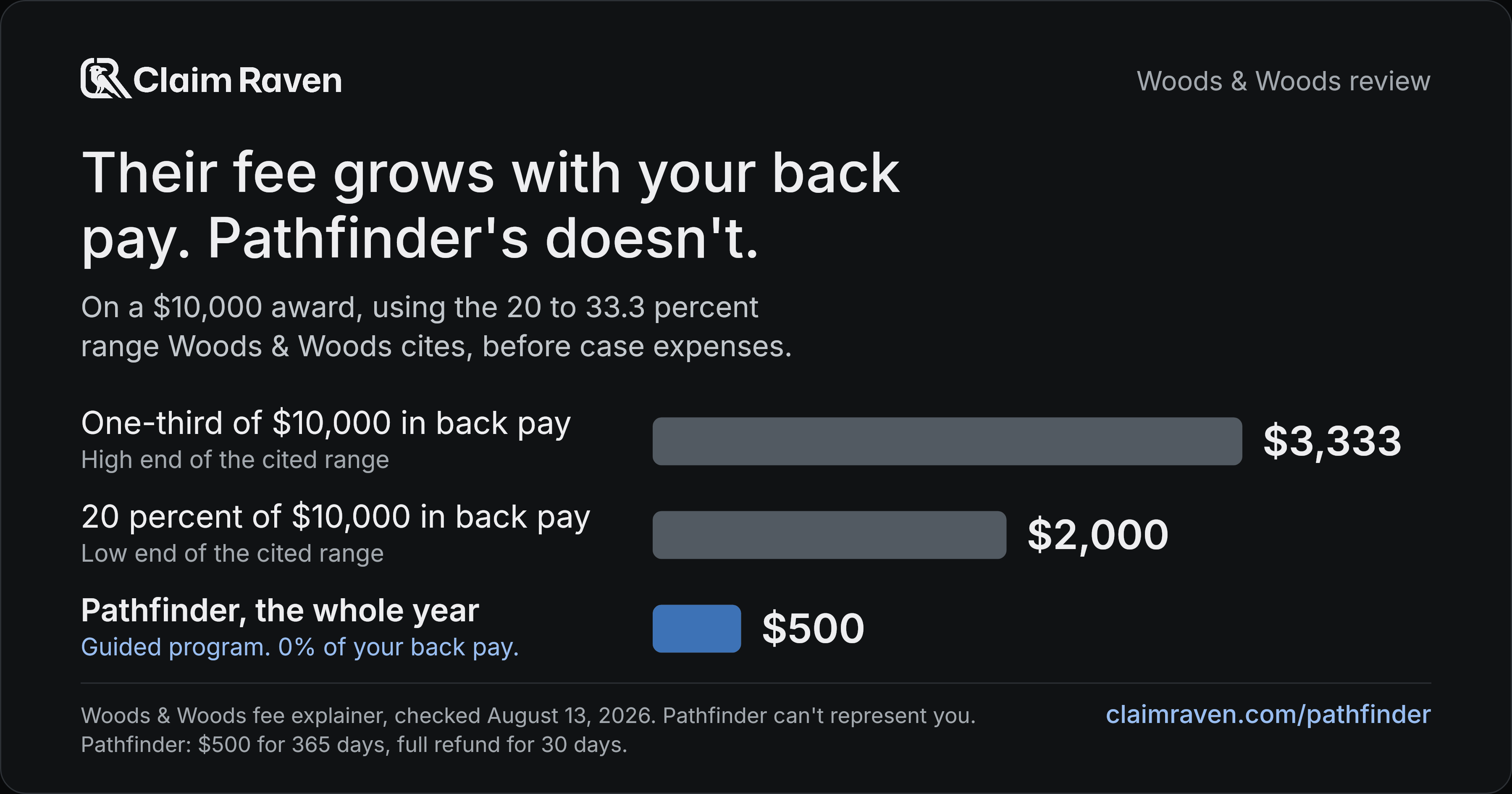 Woods & Woods Review: Fees, Expenses, and VA Appeal Scope
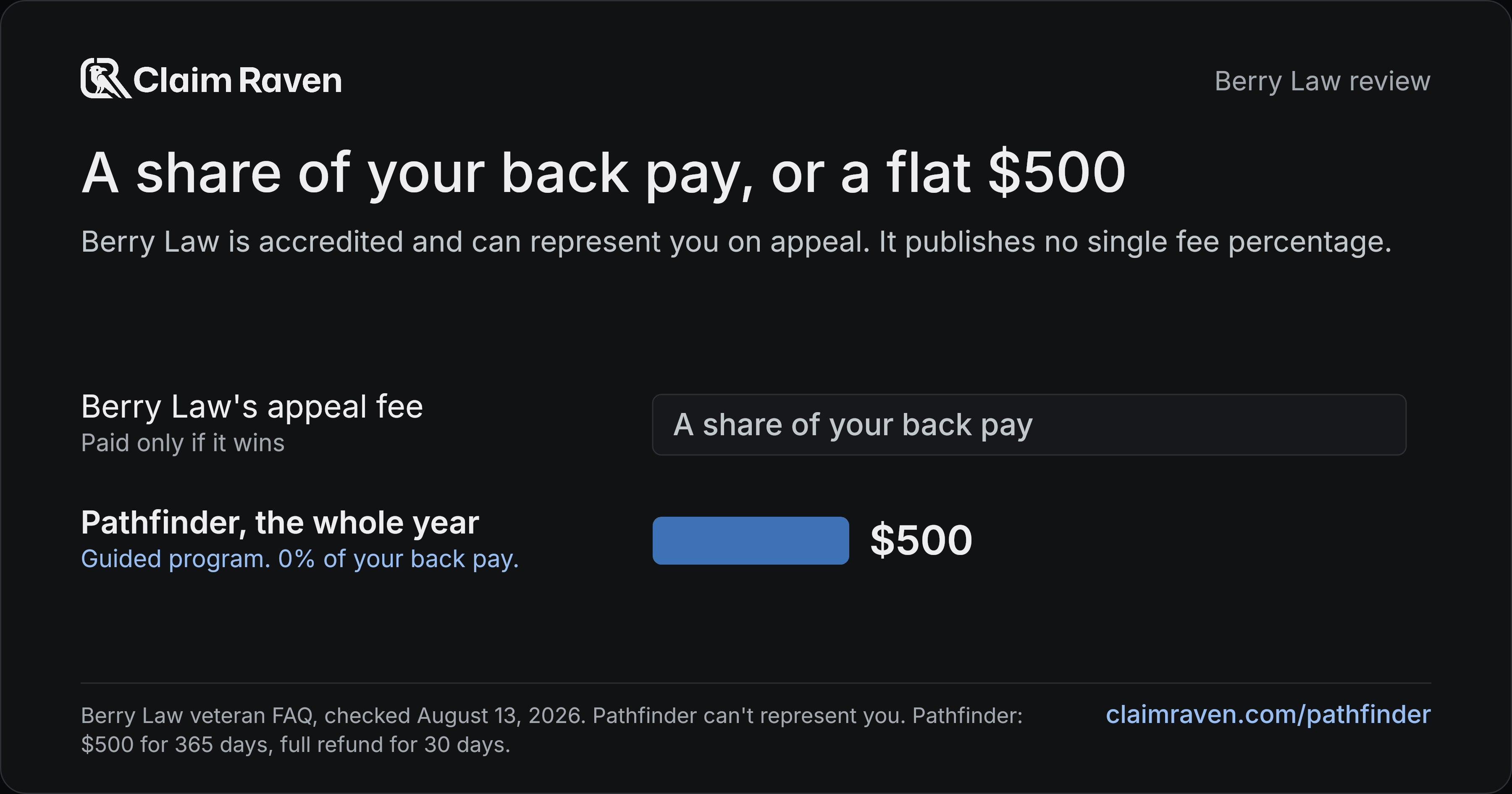 Berry Law Review: VA Appeal Fees, Services, and Contract Questions
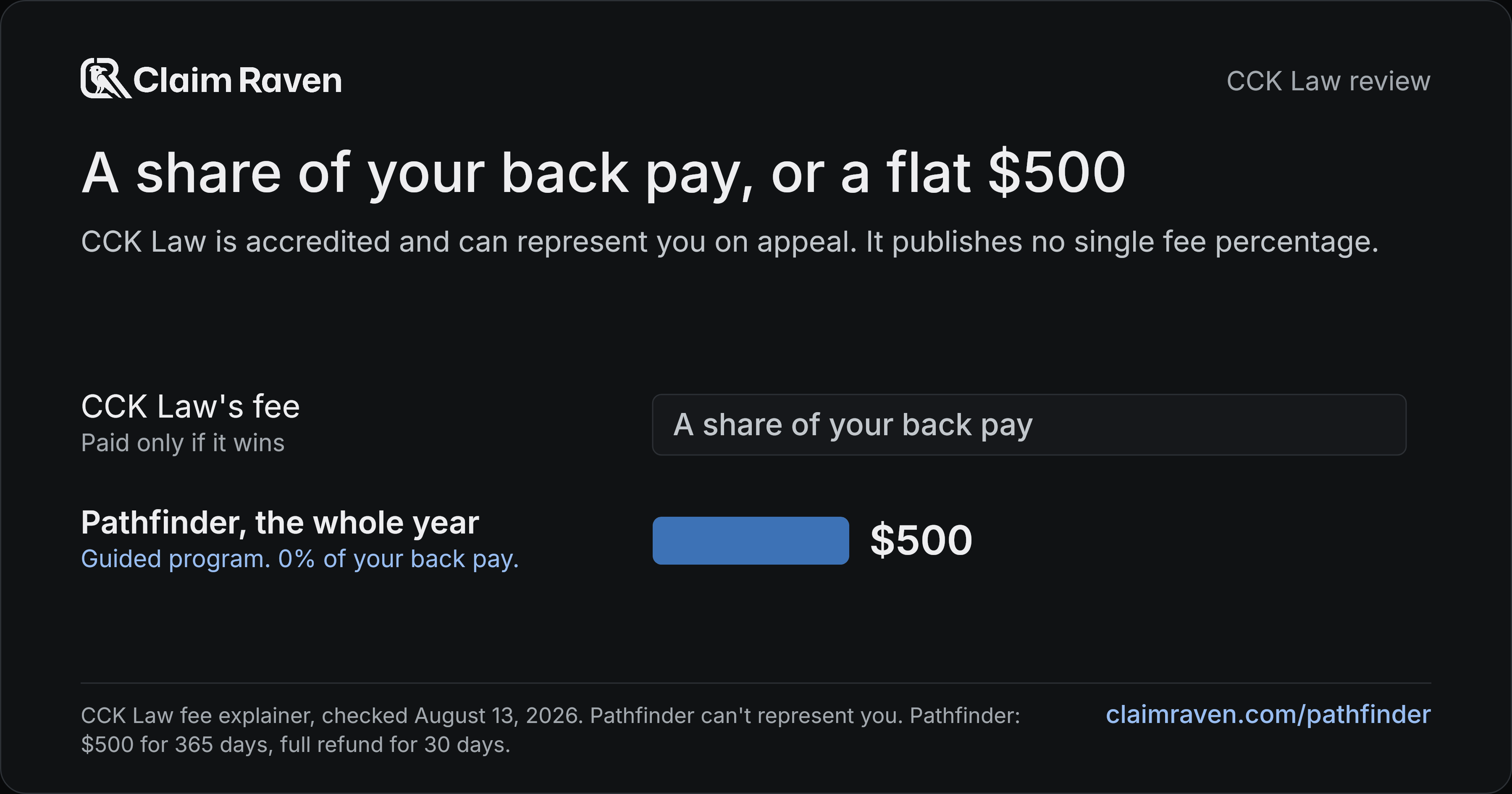 CCK Law Review: Fees, Appeals, and Questions Before You Sign