

A veteran I talked to last year filed his first claim 8 months after he separated. The decision came back at 50%. He was thrilled, until he ran the back-pay math and realized he'd filed his Intent to File the same day as the actual claim, instead of 8 months earlier when he first decided to file. Eight months of compensation at 50% is around $9,000 he left on the table because nobody told him the ITF was a separate form.
Filing a VA disability claim is one of those processes where the form you submit on day 1 matters more than the form you submit on day 30. I pulled together what the regulations say, the order the steps need to happen in to protect your back pay, and the spots where first-time filers most often lose months. The legal framework is 38 CFR § 3.155 (claim filing and Intent to File), § 3.400 (effective dates), and VA.gov guidance on Forms 21-0966 and 21-526EZ.
TL;DR
- Step 0 is the Intent to File (VA Form 21-0966). It locks your effective date and gives you 1 year to file. Most first-time filers skip it.
- Step 1 is picking your filing path. Standard claim (21-526EZ) is the default. Fully Developed Claim is faster if you have all evidence ready. BDD or Quick Start applies if you're still on active duty.
- Step 2 is building evidence. STRs come from VA. Post-service medical records, lay statements, and any nexus letter come from you.
- Step 3 is submitting. VA.gov is the fastest path. A VSO can submit on your behalf and is free.
- Step 4 is the C&P exam. Showing up and being honest about symptoms matters more than veterans realize.
- Step 5 is the decision letter. Read the full Rating Decision Narrative, not just the summary.
- The most common rookie mistakes are skipping the ITF, claiming too few conditions, and forgetting secondary conditions that chain off the primary ones.
Step 0: File the Intent to File First (VA Form 21-0966)
This is the step most first-time filers don't realize is a step. It's the single highest-impact thing you can do on day 1, and skipping it can cost you thousands.
The Intent to File is VA Form 21-0966. It tells VA "I'm planning to file a claim, lock my effective date as of today." Under 38 CFR § 3.155(b), filing an ITF gives you 1 year to file the actual claim while preserving the date you filed the ITF as your effective date. If you file the ITF on January 1 and the actual 21-526EZ on August 1, your back pay still runs from January 1 forward.
The form takes about 5 minutes. File online at VA.gov, by phone at 1-800-827-1000, or on paper. If 11 months later you decide not to pursue the claim, the ITF just expires. No downside to filing one early.
The math on why this matters. At 50% with no dependents, the 2026 monthly compensation rate is around $1,159. Every month you delay filing without an ITF on the books is roughly that much you'll never see. At 70% it's around $1,756/month. At 100% it's $4,044.91/month. Veterans who file the ITF in January and the formal claim in September capture 8 months of compensation as retro pay. Veterans who file both forms in September lose those 8 months entirely.
The pattern I see most often is veterans who file the ITF the same day they file the 21-526EZ. The ITF in that scenario protects nothing because you already have the same effective date from the claim filing itself. The whole point is to file it when you first decide to claim, not when you're finally ready to submit.
Step 1: Pick Your Filing Path
Once the ITF is in, the next question is which claim form fits your situation. Four paths.
Standard Claim (VA Form 21-526EZ)
The default. You file the 21-526EZ, list every condition you want claimed, attach what evidence you have, and let VA do the rest of the development work under their duty to assist. VA pulls your service treatment records, requests private records you authorize, schedules C&P exams, and writes a decision. Most first-time claims go through this path.
Fully Developed Claim (FDC)
A faster track for veterans who already have all their evidence in hand. You file the same 21-526EZ but check the FDC box and certify that you've submitted everything you have. Under FDC rules, VA still has a duty to assist with federal records (STRs, VA medical records), but they don't chase private medical records, lay statements, or nexus letters that you didn't include.
When FDC works well: veterans who already have current private medical records, a clear in-service event documented in STRs, lay statements written, and (if needed) a nexus letter from a treating physician. The reward is a faster decision.
When FDC backfires: veterans who think they have everything but are missing a piece VA would've gathered automatically under standard processing. A common one is private treatment records the veteran knows about but hasn't pulled. Under standard processing, VA requests them. Under FDC, VA assumes you already have everything.
For context on how appeal route correlates with outcome in the broader BVA dataset, in Claim Raven's analysis of 101,518 condition records drawn from the analyzed subset of Claim Raven's 501,000+ Board-decision library, the supplemental claim lane shows the highest grant rate at 30.7% (1,309 cases), followed by board evidence at 24.7% (19,544), board direct at 23.5% (43,118), and HLR at 15.2% (1,715). The pattern that veterans submitting a tighter, more complete evidence package on the front end (the FDC equivalent at the appeals stage) come out better holds across the dataset.
Pre-Discharge: BDD (180-90 days before separation)
If you're still on active duty and your separation date is 90-180 days out, the Benefits Delivery at Discharge program lets you file before you separate. VA processes the claim in parallel with your transition, your C&P exams happen on or near base, and the goal is a rating decision within 30 days of discharge. The effective date is the day after discharge. I wrote a separate breakdown of how BDD actually flows.
Pre-Discharge: Quick Start (89-1 days before separation)
The fallback when you've missed the 90-day BDD cutoff but you're still on active duty. Same forms as BDD, no 30-day post-discharge decision goal, but you still get to do exam work in-service and you preserve the effective date of the day after discharge.
The single most common BDD mistake I see is veterans who file at 89 days because "around 90" felt close enough. The cutoff is rigid. 90 is BDD. 89 is Quick Start.
Step 2: Build Your Evidence
Once you've picked the form, the substance of the claim is the evidence. Four buckets matter.
Service Treatment Records (STRs)
The medical records from your time in service. VA pulls these automatically under the duty to assist, so you don't have to submit them. Grabbing a copy anyway is worth the trouble for two reasons.
First, if your records were affected by the 1973 St. Louis fire at the National Personnel Records Center (mostly Army and Air Force veterans who separated before 1973), the request can drag for months or come back incomplete. Second, having your own copy lets you review what's documented and identify in-service events you might've forgotten about. The "I claimed knees but forgot to claim the shoulder injury from 2009" pattern is common.
Request STRs through the National Archives at archives.gov or eVetRecs. Free.
Post-Service Medical Records
Records from civilian providers after you separated. VA can request these if you authorize with VA Form 21-4142 (Authorization to Disclose Information), but the request waits on the provider to respond. Providers don't always respond quickly, and some don't respond at all.
The pattern I see: veterans who pull their own copies and upload them directly through VA.gov get faster development than veterans who rely on VA to pull them. The records that matter most are anything showing continuity of symptoms from service to present (the strongest single piece of evidence for service connection), a current diagnosis, and any imaging or specialist reports relevant to the conditions.
Lay Statements
Written statements from people who can speak to your condition.
Your own statement. A first-person account of when symptoms started, what they're like, how they affect your daily life. Filed on VA Form 21-4138 (Statement in Support of Claim). Specific is better than general. "I've had ringing in my ears since the 2008 deployment when I was 50 meters from a vehicle-borne IED" lands better than "I have hearing problems from service."
Buddy statements. Statements from people who knew you in service or after. A battle buddy who can confirm the explosion happened. A spouse who can describe how your sleep changed after deployment. Buddy statements work best when they're specific about timing, what the person observed firsthand, and how their observations connect to evidence already in the file.
From reading BVA decisions, lay statements that judges describe as decisive share a few features. Specific about timing. Describe what the person actually observed. Connect to symptoms or events documented in the STRs or post-service records, not floating on their own.
Nexus Letter
A medical opinion from a qualified provider that connects your current condition to an in-service event or exposure. The language VA looks for is "at least as likely as not" (50/50 or better) that the condition was caused by or aggravated by service.
Not every claim needs a private nexus letter. Some service connections are obvious from the records alone (a knee injury documented in service with continuing complaints in post-service records). Some are presumptive under 38 CFR § 3.309 (certain conditions for veterans with Agent Orange exposure, Camp Lejeune water, or PACT Act qualifying service). Presumptive claims don't require you to prove the nexus.
When the nexus isn't obvious and the condition isn't presumptive, a nexus letter from a private physician (typically a treating provider) is what closes the gap. The opinion has to come from a qualified medical professional, has to include a rationale (not just a checkbox), and has to address whether the condition is "at least as likely as not" related to service.
From my read of BVA decisions, the nexus question is where a large share of denials cluster. Either VA examiners wrote opinions concluding the condition wasn't related to service, no nexus opinion was in the file at all, or the opinion that existed didn't include a clear rationale.
In Claim Raven's analysis of 101,518 condition records drawn from the analyzed subset of Claim Raven's 501,000+ Board-decision library, nexus quality is the single strongest predictor of outcome. Strong nexus produced an 89.5% grant rate (12,509 cases), adequate nexus hit 68.9% (18,597), weak nexus collapsed to 3.3% (18,260), and missing nexus fell to 1.5% (10,718). The 18,260 cases sitting in the "weak nexus" bucket are the ones where a private nexus letter from a treating physician, written with a clear rationale and "at least as likely as not" language, would have most likely moved the file into the adequate or strong category.
Step 3: Submit the Claim
Three submission paths.
Online via VA.gov. The fastest path. Log in, fill out the 21-526EZ in the online form, upload your evidence as PDFs, and submit. The system date-stamps your filing immediately. If you filed an ITF first through VA.gov, the system tracks the 1-year window and links it to the formal claim.
Paper. Mail the 21-526EZ and your evidence to the VA Evidence Intake Center. Paper takes longer because someone has to scan everything into the Veterans Benefits Management System (VBMS). Add 1-3 weeks to the front end. Copy everything before you mail and send with tracking.
Via a VSO. A Veterans Service Officer can submit on your behalf. VSOs are free under 38 CFR § 14.629. The big ones (DAV, AMVETS, VFW, American Legion, MOPH, PVA, plus state-level VSOs) have offices in most states. A VSO can help you decide which path fits your situation, review your evidence before you submit, submit the claim through their digital portal, and represent you on any appeals. Find one through va.gov/ogc/apps/accreditation.
Step 4: The C&P Exam
After you submit, VA moves into Evidence Gathering, and one of the things that happens there is C&P exam scheduling. The Compensation and Pension exam is the in-person (or sometimes virtual) evaluation a VA examiner or contracted provider conducts to assess the conditions you claimed.
The examiner uses Disability Benefits Questionnaires (DBQs) tied to the rating schedule in 38 CFR Part 4. The DBQ output feeds directly into the rating the RVSR will write. C&P exams are commonly contracted to VES, QTC, or LHI. Examiner quality varies, and that variation shows up in BVA decisions.
What helps in the exam:
- Show up on time. Missed exams add 60-90 days easily.
- Bring a list of your symptoms and how they affect your daily life.
- Be honest about flare-ups and painful days. The examiner only documents what you say.
- Don't minimize. A lot of veterans walk in and underreport because they're trained to push through pain.
- Don't exaggerate either. Inconsistencies between your reported symptoms and the documented record undermine the opinion.
If the exam comes back inadequate, the RVSR can request a supplemental exam. That's a common reason the progress bar moves backward in Stage 4 or 5.
Step 5: The Decision Letter
Eventually the claim closes and you get a decision letter. The packet contains a one-page summary listing the conditions and the rating for each, the full Rating Decision Narrative (the rater's reasoning for each condition, usually 5-30 pages), a Codesheet showing diagnostic codes and effective dates, and your appeal rights notice.
The summary tells you the headline. The Narrative tells you why. If anything looks wrong, the Narrative is where you find the reasoning to figure out whether the disagreement is worth appealing.
The single biggest mistake at this stage is veterans who only read the summary, see "50% combined," celebrate the grant, and miss the denial buried on page 17. Combined ratings work on VA math (a non-linear formula in 38 CFR § 4.25), so a 50% combined could be a single condition rated at 50% or four conditions rated at 10-30 each. If one of those four came back denied, that's worth knowing about and potentially worth appealing.
Read the full Rating Decision Narrative. Every page.
If the decision is unfavorable in whole or in part, the 1-year appeal window under 38 USC § 5104(b) starts the day the decision is mailed. Three lanes available under the Appeals Modernization Act: Higher-Level Review, Supplemental Claim, and Board Appeal.
Common Rookie Mistakes
Skipping the Intent to File. Already covered, but worth repeating. The single most expensive mistake first-timers make.
Claiming too few conditions. A lot of first-time filers claim 2 or 3 conditions when their STRs show 8 or 10 they could've claimed. The framing problem is "I don't want to seem greedy." You're entitled to file for any condition documented in service that you still have symptoms from. A grant for tinnitus doesn't take anything away from another veteran.
The combined rating math also rewards claiming everything. Three conditions at 10% each combine to 27% (rounds up to 30%). One condition at 10% rates at 10%. The combined rating drives monthly compensation, VA healthcare priority groups, and a stack of state and federal benefits tied to overall percentage. From reading BVA decisions, veterans who underclaim on the original filing often spend years filing supplemental claims trying to add conditions they could've claimed up front.
Forgetting secondary conditions. Secondary conditions are conditions caused or aggravated by an already service-connected condition. Under 38 CFR § 3.310, they're separately ratable. Common chains:
- PTSD → sleep apnea → hypertension → migraines
- Knee injury → altered gait → back problems → sciatica
- Back condition → radiculopathy in the legs
- Diabetes → peripheral neuropathy, retinopathy, nephropathy
A veteran filing for PTSD who also has sleep apnea, hypertension, and migraines often only files for the PTSD because those are the symptoms they came in thinking about. The secondaries are separately ratable and worth claiming when the chain is documented. Secondary claims usually need a nexus opinion tying the secondary to the primary.
Not reading the decision letter. Reading the full Rating Decision Narrative is the only way to know what actually happened. The summary is a courtesy.
Missing the appeal window. The 1-year appeal window runs from the date the decision was mailed. If you miss it, the decision becomes final and reopening requires a CUE motion (38 CFR § 3.105(a)) or new and relevant evidence. The clock is the clock.
Why Talking to a VSO Before You File Pays Off
For most VA claim work, I think veterans can do a lot of the document gathering themselves. The first claim is one of the exceptions where having a VSO involved tends to produce better outcomes.
The reasons are mostly about catching the things you don't know you're missing. A VSO who files first claims every week notices when you forgot the ITF, you're underclaiming conditions documented in your STRs, you're missing a secondary that chains off something you did claim, or your evidence has a gap that's going to lead to a preventable denial.
The cost is zero. They're free under federal law (38 CFR § 14.629). DAV, AMVETS, VFW, American Legion, MOPH, PVA, and dozens of state-level VSOs maintain accredited representatives across the country. Find one through va.gov/ogc/apps/accreditation.
I'm not a VSO. Claim Raven is a data analytics tool, not an accredited representative. The tool helps veterans understand patterns in BVA decisions, decode their decision letters, and analyze their files for issues. A VSO provides personalized guidance on a specific claim, which no tool can do. Both have a role. For a first-time filer, the VSO conversation comes first.
After you submit, the claim moves through 8 stages on the VA.gov tracker. Stage 3 (Evidence Gathering) is where most claims spend most of their time. Stage 5 is where the rating decision gets written. Stage 8 is when the decision letter is mailed. The full breakdown is in a separate post on the 8 stages of a VA claim.
Bottom Line
Filing a VA disability claim is mostly about doing the steps in the right order. Step 0, the Intent to File, is the one most first-timers skip and the one that costs the most when skipped. Step 1, picking the right form, depends on whether you're in service, out with evidence in hand, or out still gathering evidence. Step 2 is building evidence across four buckets: STRs (VA pulls), post-service records (you submit or authorize), lay statements (you write), and a nexus letter (when the connection isn't obvious or presumptive). Step 3 is submitting through VA.gov or a VSO. Step 4 is the C&P exam, where being on time and being honest about symptoms matters more than veterans realize. Step 5 is reading the full decision letter, every page. The rookie mistakes that cost the most are skipping the ITF, claiming too few conditions, and missing secondary chains. If you do nothing else from this post, file the ITF today and find a VSO tomorrow.
Methodology and Limitations
- Sources: 38 CFR § 3.155 (claim filing and Intent to File), § 3.400 (effective dates), § 3.309 (presumptive service connection), § 3.310 (secondary service connection), § 3.105(a) (CUE), § 14.629 (accreditation), 38 USC § 5104 (notification and appeals), VA.gov published guidance on Forms 21-0966, 21-526EZ, 21-4138, and 21-4142, and Claim Raven's reading of public BVA decisions to identify common denial patterns and evidence gaps in first-time claims.
- What this is: A walk-through of how the filing process flows in practice and the most common places first-time filers lose time or money, based on regulatory language and observable patterns in claim outcomes.
- What this isn't: Personalized guidance. Filing strategy depends on individual evidence, service history, and timing in ways that vary case by case.
- Limitations:
- Compensation rate figures use 2026 VA disability rates, which adjust annually for COLA.
- Processing times vary by RO and by claim type. Timeline targets cited are VA's published goals, not guarantees.
- BVA decisions referenced are a selection-biased sample (cases that got denied or partially denied at the RO and were appealed). Patterns from BVA are not predictive of any individual RO outcome.
Disclaimer
This post is educational intelligence, not legal advice. Per 38 CFR § 14.629, only VA-accredited representatives (VSOs, claims agents, or attorneys) may provide personalized guidance on specific claims. The patterns described here are drawn from regulatory language, published VA guidance, and Claim Raven's analysis of public BVA decisions involving first-time claims. For guidance on your specific situation, contact an accredited VSO, claims agent, or attorney. Find accredited representatives at VA.gov.
I'm not accredited by VA, not a lawyer, not a VSO. This is data analysis, not claim advice. These are patterns from cases that made it to the BVA, and they don't predict individual outcomes.
Where to go next
- Related article: The 8 Stages of a VA Claim, and What's Actually Happening in Each One
- Relevant tool: Evidence Checklists, to build your record before submission
- More analysis: /blog
- Disclaimer: Claim Raven is data analysis, not legal, medical, or VA-accredited advice.
-Landon Founder, Claim Raven | U.S. Army Veteran
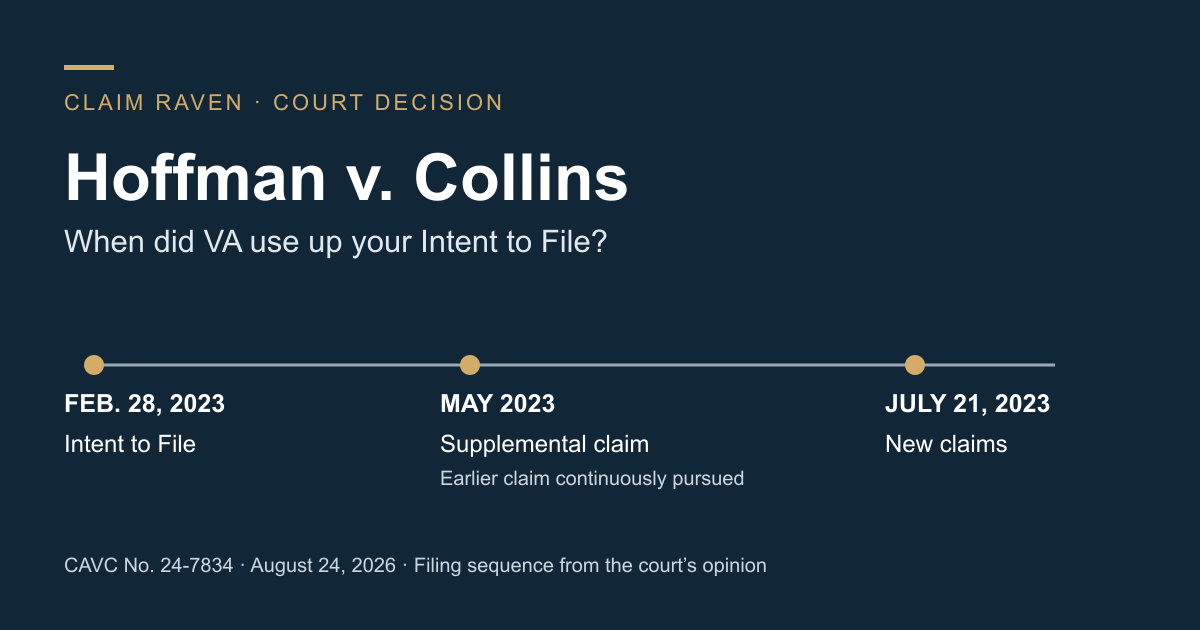 Hoffman v. Collins: When a Supplemental Claim Cannot Use Up Your Intent to File
 PTSD Back Pay Has a Deadline: How Five Days Cost This Veteran Eleven Months of Retro Pay
 A Schizoaffective VA Rating: Denied Three Times, Then 70 Percent With Back Pay to 2010