
Robert Hoffman filed an Intent to File in February 2023. He submitted his new disability claims that July, comfortably inside the one-year window. VA granted the claims but used the July filing date.
VA said an intervening supplemental claim had already used up his Intent to File.
On August 24, 2026, the Veterans Court held that VA cannot consume an Intent to File on a continuously pursued supplemental claim when that provides no effective-date benefit. That distinction can matter when a later new claim was filed within the same Intent to File window. Hoffman v. Collins, No. 24-7834, opinion pp. 1–2
If your decision used the date of your completed claim because VA treated an earlier supplemental claim as having consumed your Intent to File, this is a decision worth understanding. The useful first step is comparing the filing sequence with your records. Our free ITF date checker can help you organize that comparison.
What did Hoffman v. Collins change?
- The ruling concerns a continuously pursued supplemental claim: in this case, a timely request to review earlier denials, preserving the original application date.
- That claim already had an earlier application date under the statute. Associating the newer Intent to File with it provided no date benefit.
- VA could not use that association to deny the benefit of the Intent to File to Hoffman's later new claim.
- The court ordered February 28, 2023, as the effective date for his stroke residuals. It returned the erectile dysfunction and related special monthly compensation date questions for further proceedings.
- The decision does not mean that every supplemental claim leaves an Intent to File untouched, or that every earlier Intent to File produces additional compensation. Opinion pp. 2, 12–18
Three filings explain the dispute
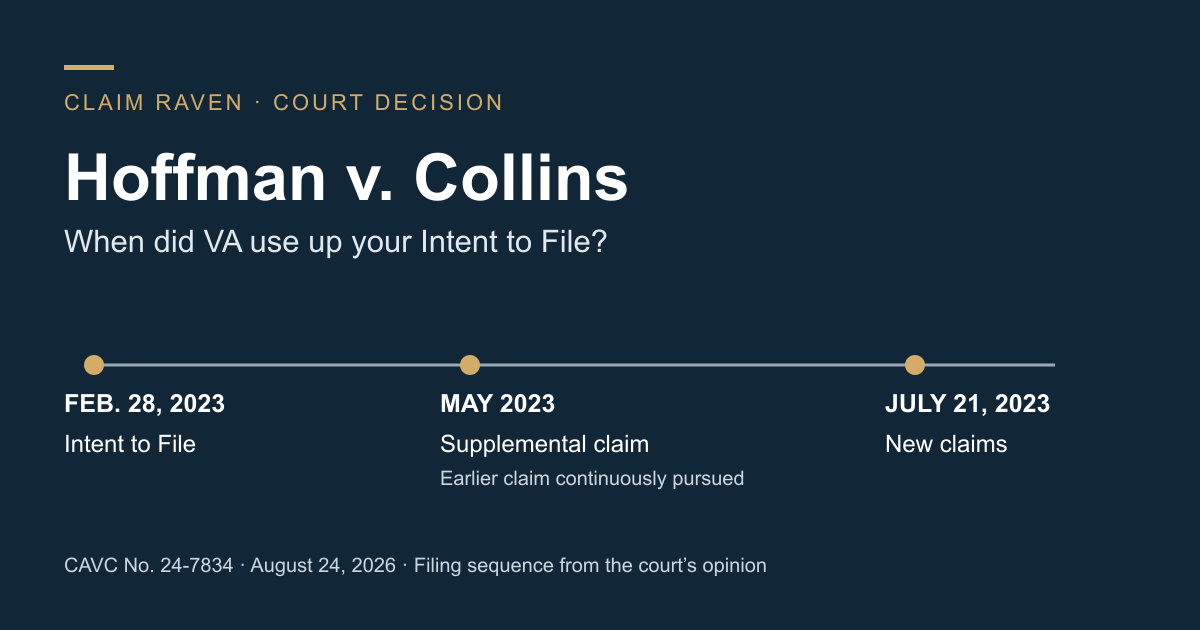
Here is the sequence in the court's opinion:
| Date | What Hoffman filed | Why it mattered |
|---|---|---|
| February 28, 2023 | Intent to File for compensation | Established the potential application date for a later completed claim. |
| May 2023 | Supplemental claim concerning kidney disease, hearing loss, and Meniere's disease | Continued claims he had already been pursuing. Their original application dates preceded the Intent to File. |
| July 21, 2023 | New claims for stroke residuals and erectile dysfunction | Arrived within one year of the Intent to File. |
The Board treated the May supplemental claim as the first completed claim after the February Intent to File. Under its reading of 38 C.F.R. § 3.155(d)(1)(ii), that consumed the Intent to File and left the July claims with July application dates. Opinion pp. 3–4
The problem was that the May claim did not need the February date.
The earlier claim already had its own date protection
An Intent to File tells VA that you plan to submit a claim. For qualifying claims, submitting the completed application within one year can preserve the Intent to File as the application date. VA's Intent to File guidance
Continuous pursuit is a different protection. Under 38 U.S.C. § 5110(a)(2), using qualifying review options within the required time can preserve the initial application date. Hoffman's May supplemental claim continued that earlier claim history. Opinion pp. 4–5, 12–13
There were two separate clocks: the time to continue the existing claim and the time to complete a new claim after an Intent to File. Treating the timely supplemental claim as consuming the Intent to File deprived Hoffman of the second protection without adding anything to the first.
That is the specific problem the court addressed. It held the regulation invalid as applied to those continuously pursued supplemental claims. Opinion pp. 13–16
Supplemental claims can still benefit from an Intent to File
It would be a mistake to read Hoffman as saying that supplemental claims never use an Intent to File.
The court distinguished continuously pursued supplemental claims from supplemental claims filed after the continuous-pursuit period. An Intent to File can provide a useful earlier application date in the latter situation. Hoffman explains this alongside the Federal Circuit's 2021 decision in Military-Veterans Advocacy, which invalidated VA's blanket exclusion of supplemental claims from the Intent to File framework. Opinion pp. 7, 11–16
The practical distinction is whether the supplemental claim already preserves an earlier application date through continuous pursuit. The label “supplemental claim” alone does not answer that.
Nor should you treat an Intent to File as automatically extending the separate deadline for continuous pursuit. VA generally explains that a Supplemental Claim must be filed within one year of the decision letter to maintain the effective date. Review options and exceptions depend on the procedural history. VA's Supplemental Claim guidance
Winning the filing-date question did not settle every effective date
Hoffman's stroke-residuals award received the February 28, 2023, effective date because the Board had already made the necessary factual finding about his stroke history.
The erectile dysfunction evidence was less clear. It included conflicting information about onset and diagnosis. The court returned that question to the Board. The related special monthly compensation question depended on it. Special monthly compensation is additional compensation for certain qualifying disabilities or losses; in this case, the award concerned loss of use of a creative organ. Opinion pp. 1–2, 16–18
The distinction matters: an earlier application date does not resolve when all the requirements for the benefit were met. VA's effective-date guidance generally describes the date for direct service connection as the later of the claim date or the date entitlement arose, subject to applicable exceptions. VA effective-date guidance
This is why I would not turn the case into a promise of a specific amount of back pay. The court did not establish a universal dollar amount. Compensation calculations also distinguish the effective date from when payment may begin. VA General Counsel, VAOPGCPREC 2-2019, discussion of 38 U.S.C. § 5111
Could Hoffman v. Collins affect your VA claim?
If the sequence sounds familiar, the useful question is whether the records establish each part of it.
Gather:
- The Intent to File acknowledgement. Find VA's receipt date and the benefit type.
- The earlier decision and review history. Identify the issue being continued, the decision-notice dates, and the review filings. One recent date alone may not establish the full chain.
- The supplemental-claim receipt. Confirm what VA received and when.
- The later new-claim receipt. Check whether it arrived within the Intent to File window and whether other claims were filed in between.
- The award decision. Find the assigned effective date and VA's explanation for not using the Intent to File.
- Evidence about when entitlement arose. The filing history and the evidence supporting the benefit answer different questions.
A useful question for an accredited representative is: “Did VA associate this Intent to File with a continuously pursued supplemental claim that received no effective-date benefit, then decline to apply it to my later new claim?”
Include the date and type of the decision you want reviewed. The available review process depends on those facts. A regional-office decision and a Board decision do not have identical review paths. VA decision reviews and appeals
Does Hoffman reopen an old final decision?
Hoffman does not automatically reopen every final effective-date decision.
The Supreme Court has held that the later invalidation of a VA regulation does not, by itself, establish clear and unmistakable error in a final decision that applied the regulation. That is the holding of George v. McDonough. It is a reason to have the procedural history reviewed, not to assume Hoffman automatically supports a CUE filing. George v. McDonough, opinion pp. 1, 7–8
If you have a decision letter, keep its review instructions with your timeline. Reading about a new case does not pause an existing deadline.
Start with the date VA used and the reason it gave
The most useful record check is specific: compare the Intent to File acknowledgement, the supplemental-claim history, the later claim receipt, and the award's effective-date explanation.
Use the free Intent to File date checker to compare that sequence, build a timeline, and get a records checklist. It takes no signup or upload, and your entries stay in the page. The result identifies questions to review; it does not determine an award, calculate back pay, or confirm a filing deadline. For help reviewing your own claim, an accredited VSO representative provides claims assistance for free. VA also lists accredited attorneys and claims agents. Find accredited help through VA
Sources and limits
This article analyzes one precedential CAVC panel opinion, Hoffman v. Collins, No. 24-7834, issued August 24, 2026. The majority's operative analysis and disposition appear on pages 1–18. Judge Jaquith's separate concurrence discusses waiver and fair process; those separate views are not an additional majority holding.
The official opinion and public docket summary were checked September 9, 2026. The latest docket entry displayed was the August 24 opinion; no later judgment, mandate, reconsideration, or stay entry appeared in that summary. That observation does not predict further proceedings or establish that every VA system has been updated. Official opinions list · Public docket summary
This is an explanation of the decision, not a study of how often VA made this error or a determination of anyone's entitlement. I'm not a lawyer or VA-accredited representative. For advice on your particular claim or review deadline, work with an accredited representative.
 Hamill v. Collins: The VA Can No Longer Deny Your Claim in Silence
 How to File a VA Disability Claim: The Step-by-Step Process for First-Timers
 The VA Closed Thousands of Veterans' Appeals by Mistake. Freund v. Collins Forces Them to Look Again