

A 100% single veteran with no dependents receives roughly $3,831 per month in 2026. None of it appears on a federal tax return. None of it shows up on a W-2 or a 1099. The IRS doesn't get a copy. That's not a loophole, it's the statute working exactly as Congress wrote it.
Every January I get the same question, sometimes phrased five different ways. Do I owe taxes on my VA disability. Does my state want a piece. Why didn't I get a 1099. Does it count for the earned income credit. What about SSDI, CRSC, that property tax exemption my buddy mentioned. The federal answer is simple. The state and offset answers are where it gets layered. I wanted to put the full tax picture in one place, point at the statute that makes VA disability tax-free, and walk through the interactions that catch people off guard.
TL;DR
- VA disability compensation is federally tax-free under IRC § 104(a)(4), no exceptions
- The exemption covers everything VA pays as disability comp, including SMC, dependent additions, retro payments, A&A, Housebound, and CRSC
- Most states follow the federal exemption because state income tax usually starts from federal AGI, where VA disability never shows up
- SSDI is taxable above certain income thresholds under 26 USC § 86, but VA disability isn't counted in the SSDI taxability formula
- Combat-Related Special Compensation (CRSC) under 10 USC § 1413a is tax-free; Concurrent Receipt (CRDP) under 10 USC § 1414 is taxable as restored retired pay
- The VA doesn't send 1099s for disability compensation; lenders accept VA benefit verification letters instead
- State property tax exemptions for disabled veterans are separate from income tax treatment and vary widely
Why VA Disability Is Federally Tax-Free
The statute is IRC § 104(a)(4), codified at 26 USC § 104(a)(4). Section 104 is titled "Compensation for injuries or sickness," and subsection (a)(4) specifically exempts "amounts received as a pension, annuity, or similar allowance for personal injuries or sickness resulting from active service in the armed forces of any country."
That's the whole basis for the federal exemption. VA disability compensation is treated by Congress as compensation for an injury sustained in service, not as income. It's the same legal theory that makes lawsuit damages for physical injury tax-free under IRC § 104(a)(2). The money isn't income. It's a payment for harm.
The IRS reinforces this in Publication 525, which explicitly lists VA disability benefits as non-taxable. If the VA paid it as part of a disability-related program, the IRS doesn't tax it.
The clean way to think about it: VA disability isn't tax-deductible, it's pre-tax. It never enters the tax system to begin with. There's no line on Form 1040 for it, no Schedule 1 entry, no adjustment, nothing. The money flows from VA to veteran and the IRS has no claim on it at any step.
What "All VA Disability" Actually Covers
When the statute says "pension, annuity, or similar allowance," it sweeps in more than just the monthly base rate. Here's what's included in the federal exemption:
- Base monthly compensation at any rating, single or with dependents
- Dependent additions for spouse, children, and dependent parents
- Special Monthly Compensation (SMC) at every level K through T, plus A&A and Housebound enhancements
- Retroactive pay when a claim is granted with an earlier effective date, even lump sums of $50,000+
- Combat-Related Special Compensation (CRSC) paid by DFAS, specifically excluded from gross income by 10 USC § 1413a
- Clothing allowance for veterans whose conditions damage clothes
- Adaptive housing and vehicle grants (SAH, SHA, auto grants)
- Dependency and Indemnity Compensation (DIC) paid to survivors
There's no carve-out for high-dollar payments, no income limit, no threshold above which it suddenly becomes taxable. A veteran getting $50,000 per year in disability and SMC pays zero federal tax on it. So does a veteran getting $4,000.
State Tax Treatment Mostly Tracks Federal
State income tax is a different statute in every state, but the practical effect is that most states don't tax VA disability either.
State income tax in most states starts from federal Adjusted Gross Income (AGI) or federal taxable income, then makes state-specific adjustments. VA disability never enters federal AGI to begin with, because IRC § 104(a)(4) keeps it out of the federal tax calculation entirely. So when a state pulls federal AGI as the starting point, VA disability is already invisible. The state doesn't have to do anything special. It's already excluded.
This is true for the large majority of states with an income tax. A handful of states have explicit statutory exemptions for VA disability on top of that, which is belt-and-suspenders since federal AGI doesn't include it anyway.
The states with no individual income tax on wages don't tax it because they don't tax any wage income. That's nine states as of when I'm writing this: Alaska, Florida, Nevada, New Hampshire, South Dakota, Tennessee, Texas, Washington, and Wyoming. New Hampshire and Tennessee historically taxed interest and dividends but not wages; those narrow taxes have been repealed or are phasing out.
I'd be careful before making absolute claims about every state, because state tax codes change and some states have quirks around military retirement, CRDP, and SSDI that interact with the picture in ways that aren't obvious. The general pattern is consistent: the federal exemption is what does the work, and most state regimes inherit it.
VA Disability vs SSDI, Two Different Tax Stories
This is the interaction that catches the most veterans off guard. SSDI and VA disability look similar from the outside. Both are disability-based monthly payments. The tax treatment couldn't be more different.
SSDI is taxable under 26 USC § 86 if your combined income exceeds certain thresholds. Combined income for this calculation means your AGI, plus tax-exempt interest, plus half of your SSDI benefits. If that combined income is above $25,000 for a single filer or $32,000 for joint filers, then some portion of your SSDI becomes taxable. Up to 85% of SSDI can end up included in taxable income at higher levels.
VA disability isn't taxed at any income level. It doesn't enter the § 86 combined-income formula either, because the formula only counts amounts that are "taxable" or "tax-exempt interest." VA disability is neither.
A worked example. Say a veteran receives $36,000 per year in VA disability (roughly 90%) and $30,000 per year in SSDI. The combined income calculation looks at: AGI from other sources (zero if this is the only income), plus tax-exempt interest (zero), plus half of SSDI ($15,000). Total combined income: $15,000. That's below the $25,000 single-filer threshold, so SSDI is fully tax-free in this scenario, even though the veteran's total benefit income is $66,000.
If the same veteran also has $20,000 in wages from a part-time job, combined income becomes $20,000 + $15,000 = $35,000. That's above the threshold, so a portion of SSDI becomes taxable. The VA disability still doesn't enter the math.
The point is, VA disability is invisible in the SSDI taxability formula. Veterans who get both should expect to pay tax on some of their SSDI eventually if they have other income, but they'll never pay tax on the VA disability portion.
CRSC vs CRDP, The Tax Difference Between Them
Combat-Related Special Compensation and Concurrent Receipt of Disability Pay are both programs that address the historical military-retired-pay vs VA-disability offset. They solve the same problem from different angles, and they have completely different tax treatments.
CRSC under 10 USC § 1413a. CRSC is for veterans with combat-related disabilities receiving military retired pay that's being offset by VA disability. CRSC is a separate payment that compensates for the combat-related portion of that offset. It's paid by DFAS but the statute specifically excludes CRSC from gross income. CRSC is tax-free at the federal level, and like VA disability, doesn't show up on a 1099.
CRDP under 10 USC § 1414. CRDP is for veterans rated 50% or higher who are entitled to both military retirement and VA disability. Instead of paying separate CRSC, CRDP restores the full retired-pay amount that would otherwise be offset by VA comp. The restored portion is military retired pay. It's paid by DFAS. And here's the catch: it's taxed as retired pay, not as VA disability.
So a retired veteran rated 70% might receive a DFAS check that includes the CRDP-restored portion. That portion is reportable as retirement income on the federal return. The VA's separate disability check remains tax-free.
The difference matters because CRSC and CRDP can have similar dollar values but very different after-tax outcomes. Veterans who are eligible for both make an annual Open Season election in January because they can't get both at once. The tax difference is one of the factors in that decision.
In practice, CRDP shows up on the veteran's 1099-R from DFAS as taxable retirement pay. CRSC shows up on a separate DFAS statement that explicitly labels it as non-taxable.
Why No 1099, And What Lenders Ask For Instead
The IRS requires 1099s for income that's taxable to the recipient. VA disability isn't taxable, so VA doesn't issue 1099s for it. That's a logical consequence of the tax-free status.
This creates a recurring headache for veterans dealing with mortgage lenders, landlords, and other parties who want to verify income but are only familiar with W-2s and 1099s.
The substitute documents that lenders generally accept:
- VA Benefit Verification Letter. Available through VA.gov in the "Letters" section of the disability dashboard. This is the official VA-issued letter stating your monthly amount. It's the document most mortgage underwriters and rental property managers want.
- Most recent VA award letter. The decision letter you received when your rating was granted or last adjusted. Lenders sometimes prefer this because it shows the rating and the effective date.
- Bank statements showing VA deposits. Less formal but often accepted as supporting documentation alongside one of the above.
When a lender insists on a 1099, the workaround is to provide the benefit verification letter and reference IRS Publication 525, which confirms VA disability is non-taxable and therefore not 1099-reportable. Underwriters who deal with veterans regularly know this. Underwriters who don't sometimes need to be pointed to the publication.
Earned Income Credit, ACA, And Means-Tested Programs
This is where the federal tax-free status has ripple effects beyond just "what's on the 1040."
Earned Income Credit (EIC)
The EIC requires earned income, meaning wages, self-employment income, or certain other compensation for work performed. VA disability isn't earned income. So VA disability doesn't help you qualify for EIC, and it also doesn't disqualify you. A 100% disabled veteran with no earned wages doesn't qualify for EIC, even with very limited real income, because EIC requires earned income to function.
ACA marketplace subsidies
ACA subsidies use Modified Adjusted Gross Income (MAGI), which is AGI plus a few specific addbacks. The addbacks don't include VA disability. Veterans on VA healthcare typically aren't using ACA marketplace plans anyway, but for family members who do, VA disability won't lower their subsidy eligibility.
Medicaid and CHIP
These programs use MAGI for most eligibility categories, which means VA disability is again invisible. Veterans whose only income is VA disability will often qualify for Medicaid in expansion states based on MAGI alone, because their reported income is effectively zero.
FAFSA
The FAFSA uses tax return data and asks about certain non-taxable income separately. VA disability is reportable on the FAFSA as a form of untaxed income. So while it doesn't increase your federal AGI, it can still factor into expected family contribution calculations for college aid.
SNAP
SNAP uses gross income tests that include most income types, and VA disability is typically counted as income for SNAP purposes.
The pattern: federal income tax and most ACA/Medicaid calculations don't see VA disability. Means-tested programs sometimes do. The federal exemption is specifically for income tax, not for "all government calculations."
State Property Tax Exemptions, A Separate Universe
State property tax exemptions for disabled veterans deserve their own post, and probably their own database. The picture varies enormously by state.
The general shape: many states offer a partial or full property tax exemption for veterans who meet certain disability rating thresholds, often tied to 100% schedular, P&T (permanent and total), or specific qualifying conditions.
A few patterns:
- 100% P&T or 100% schedular is often the magic threshold. Texas, Florida, Alabama, and others fully exempt the primary residence of a 100% P&T veteran from property tax.
- Some states scale the exemption with the rating. California offers a basic exemption that grows for veterans rated 100% P&T. Some states have multiple tiers based on rating bands.
- Some states have income tests on top of disability tests. A veteran might be 100% rated but still need to meet an income threshold to qualify for the full exemption.
- Some states extend the exemption to surviving spouses. Often this requires the veteran's death to be service-connected, but the rules vary.
The federal tax-free status of VA disability is what it is regardless of where you live, but the property tax picture changes the day you cross a state line. A veteran moving from Texas (full 100% P&T exemption) to a state with a more limited exemption will see a different effective tax position even though both states are treating VA disability income the same way (federally tax-free, state-untaxed because federal AGI doesn't include it).
Common Reporting Mistakes I See
Veterans and tax preparers occasionally do things to VA disability that they shouldn't. Here are the patterns that come up most.
Putting VA disability on Schedule 1 as "other income." I've seen this on returns prepared by tax software users who weren't sure where to put it. There's no need to put it anywhere. VA disability shouldn't appear on the 1040 at all. Including it as "other income" on Schedule 1 doesn't make it taxable (the IRS could theoretically catch the error), but it inflates AGI for purposes of other calculations (SSDI taxability, ACA subsidies, etc.) that don't actually need it included.
Trying to deduct medical expenses paid by VA. VA-provided medical care doesn't generate a tax deduction. The cost was zero to the veteran, so there's nothing to deduct under IRC § 213. Out-of-pocket medical expenses (private insurance copays, non-VA prescription costs) are deductible above the AGI threshold, but VA-covered care isn't.
Reporting CRDP as VA disability. CRDP is military retired pay restored after the VA-disability offset. It's taxable. Veterans sometimes assume the whole DFAS check is tax-free because part of it relates to their disability rating. The 1099-R from DFAS shows the taxable portion separately, and that portion belongs on the return.
Forgetting that CRSC is tax-free. The flip side of the CRDP mistake. CRSC arrives from DFAS and looks like military pay, but it's statutorily tax-free under 10 USC § 1413a. Some veterans include it as taxable income out of caution.
Retroactive disability pay treated as ordinary income. Big retro checks (sometimes $50,000 to $100,000+) hit in a single year and look like a windfall. They're still tax-free. The lump-sum nature doesn't change the underlying character of the payment.
Claiming VA disability as earned income for EIC. Doesn't work, because EIC requires earned income, and VA disability isn't earned income.
If you're using a tax preparer who isn't familiar with veterans' tax issues, the cleanest way to handle VA disability is to not mention it at all on the return. There's no schedule, no form, no entry. It exists outside the federal tax system.
A Worked Tax Example
Let me run through a realistic scenario so the math is concrete.
Say a veteran has:
- VA disability at 70%, single, no dependents: about $21,110/year in 2026
- SSDI: $24,000/year
- Part-time 1099 consulting work: $18,000/year
- CRSC for combat-related portion: $4,200/year
- SMC-K for loss of use of a creative organ: about $1,680/year
Federal return:
- VA disability ($21,110): not on the return at all
- SMC-K ($1,680): not on the return at all
- CRSC ($4,200): not on the return at all
- SSDI ($24,000): line 6a of Form 1040, taxable portion depends on combined income
- Consulting income ($18,000): Schedule C, with SE tax on Schedule SE
SSDI taxability calculation: Combined income = $18,000 (consulting) + $0 (tax-exempt interest) + $12,000 (half of SSDI) = $30,000. That's above the $25,000 single-filer threshold and below the $34,000 second tier. Taxable SSDI = lesser of 50% of SSDI ($12,000) or 50% of ($30,000 - $25,000) = $2,500.
Final AGI: $18,000 + $2,500 = $20,500.
VA disability, SMC, and CRSC totaled $26,990 of 2026 income for this veteran and added zero to AGI. Total real income for the year was $68,990. Federal AGI is $20,500. The federal tax bill is computed only on that $20,500 (minus the standard deduction, minus the deductible half of SE tax, etc.).
For most veterans receiving multiple income types, AGI is going to be dramatically lower than total household receipts. That's the whole reason a 100% disabled veteran with a small side income can sometimes show AGI under the standard deduction threshold and owe zero federal income tax in a year where they actually received $50,000+.
Bottom Line
VA disability compensation is federally tax-free under IRC § 104(a)(4), and that exemption covers everything VA pays as disability benefits: monthly comp at all ratings, SMC, dependent additions, retroactive payments, A&A, Housebound, DIC, clothing allowances, adaptive grants, and CRSC under 10 USC § 1413a. Most states inherit the exemption automatically because state income tax usually starts from federal AGI, which doesn't include VA disability. SSDI is taxable under 26 USC § 86 above certain thresholds, but VA disability isn't counted in that taxability formula. CRDP under 10 USC § 1414 restores offset military retirement and is taxable as retired pay, which is the tax distinction veterans most often get wrong. The VA doesn't issue 1099s for disability comp because there's no taxable event to report, and lenders accept benefit verification letters as substitutes. State property tax exemptions for disabled veterans are entirely separate from income tax treatment and vary widely. The cleanest way to handle VA disability on a federal return is to leave it off entirely, because it doesn't belong on any line, schedule, or form.
Methodology and Limitations
- Source for federal tax exemption: Internal Revenue Code § 104(a)(4), codified at 26 USC § 104(a)(4). Reinforced by IRS Publication 525, which lists VA disability benefits as non-taxable income.
- Source for SSDI taxability: 26 USC § 86, including the combined-income thresholds for single and joint filers and the two-tier inclusion rates (up to 50% and up to 85%).
- Source for CRSC: 10 USC § 1413a, which establishes Combat-Related Special Compensation and specifies its tax-exempt status.
- Source for CRDP: 10 USC § 1414, which establishes Concurrent Receipt of Disability Pay and the rules for restoring offset military retired pay.
- Source for compensation amounts: Approximate 2026 VA disability compensation rates reflecting the 2.8% COLA effective December 1, 2025. Rounded for readability.
- Source for SMC and dependent framework: 38 CFR § 3.350 (SMC), 38 CFR § 3.351 (compensation rates), 38 CFR § 3.250 (dependent parents), 38 CFR § 3.352 (A&A criteria).
- What this post doesn't cover: Estate tax treatment of accrued VA disability, VA pension (a separate program from disability comp), employer-sponsored disability insurance interactions, and state-by-state property tax exemption rule specifics.
- Limitations:
- State tax treatment can change with state legislation, and a few states have specific quirks around military retirement and CRDP that interact in ways not fully detailed here for every state
- The CRSC/CRDP election analysis is summarized at a high level; eligible veterans should review DFAS election materials before the annual Open Season decision
- Means-tested program rules (SNAP, Medicaid, state veterans benefits) change periodically and are administered at the state level
- Property tax exemption summaries are illustrative only and not a substitute for checking the specific state's current statutes
Disclaimer
I'm not accredited by VA, not a lawyer, not a VSO, and not a tax professional. This is data analysis of how the tax code treats VA disability benefits, not tax advice. The IRC and CFR citations above are the statutes and regulations as I understand them. If you need help with your specific tax return or your state filing, work with a tax professional who has experience with veterans' tax issues. If you need help with your claim, work with an accredited representative.
Where to go next
- Related article: VA Disability Back Pay: How It's Calculated and When You Actually Get Paid
- Relevant tool: Raven Calculator, for the rate math
- More analysis: /blog
- Disclaimer: Claim Raven is data analysis, not legal, medical, or VA-accredited advice.
-Landon Founder, Claim Raven | U.S. Army Veteran
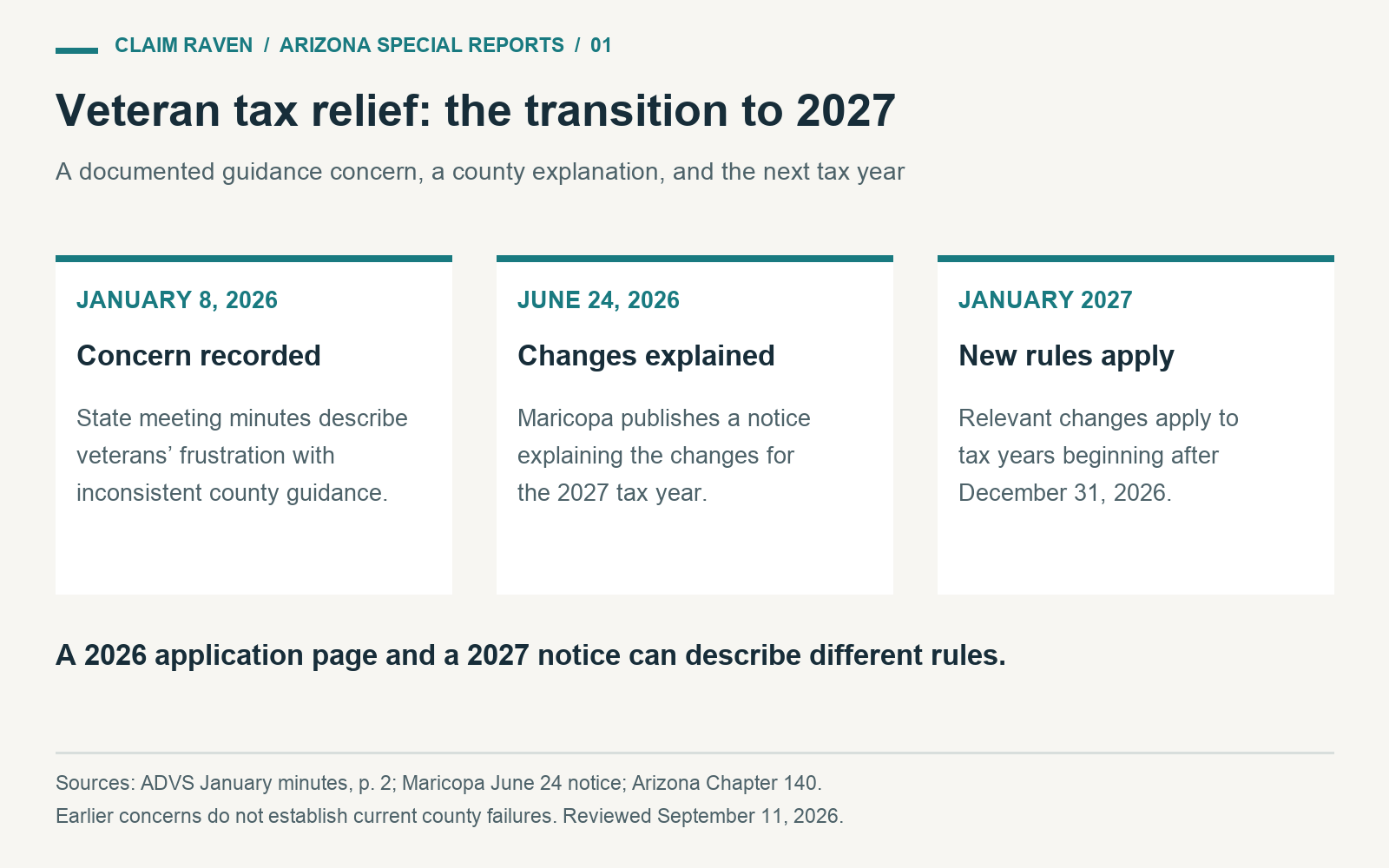 Arizona expanded veterans’ tax relief. Clear instructions are the next test.
 Veterans Guardian Review: The Five-Times Fee and the Federal Ruling
 Secondary Connection Chains That Actually Hold Up at the Board