
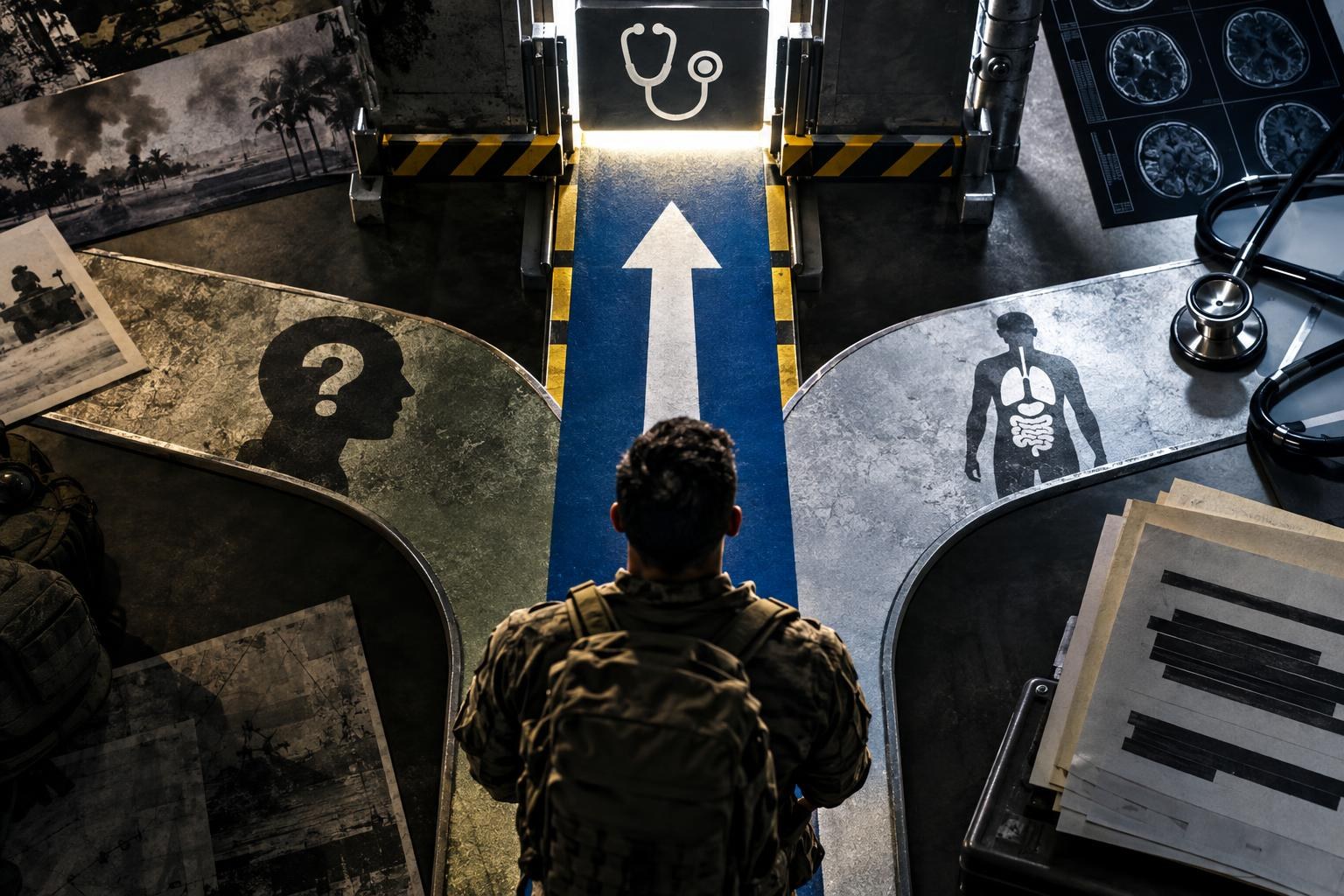
The VA recently updated M21-1, Part X, Subpart i, Chapter 6, Section F, which governs how claims processors develop and order examinations under the Integrated Disability Evaluation System (IDES). The revision targets a narrow but consequential category of claims: those involving an undiagnosed illness or a medically unexplained chronic multisymptom illness (MUCMI). If you are a service member going through IDES on your way out of the military, or a Gulf War era veteran whose symptoms have never received a firm diagnosis, the way your C&P exam gets scheduled and conducted just shifted. This is an explainer of what the new guidance does, who it touches, and how to respond so your claim does not stall on examination errors. You can review the VA's published change log directly at the VA Changes By Date portal.
What the IDES Exam Rule Means
IDES is the joint VA-DoD process that combines the military's medical evaluation board with the VA's disability rating exam, so a transitioning service member gets a VA rating decision close to the time of separation rather than waiting months or years after discharge. Section X.i.6.F of the M21-1 — the VA's internal adjudication manual — tells claims processors how to develop these IDES claims, including when to order a C&P exam, what type of exam to request, and how to handle claimed conditions that do not fit neatly into a standard diagnostic code.
Undiagnosed illness and MUCMI are categories created by Gulf War presumptive law. An undiagnosed illness is a chronic symptom — fatigue, joint pain, gastrointestinal disturbance, neurological complaints — that doctors cannot pin to a known disease. A MUCMI is a diagnosed condition like chronic fatigue syndrome, fibromyalgia, or irritable bowel syndrome that the medical community recognizes but cannot fully explain. Both categories require a specific kind of C&P exam because the examiner is not confirming a diagnosis in the usual sense. The examiner is documenting symptom clusters, ruling out alternative explanations, and applying the Gulf War presumptive framework. Section F is the operational playbook for getting that exam right inside IDES.
What This Update Actually Changes
According to the VA's published guidance, the revision to X.i.6.F refines instructions for examinations in claims involving an undiagnosed illness or MUCMI. The source abstract describes the change as updated guidance on examinations for those specific claim types within the IDES process. The relevance score and topic classification flag this as a procedural amendment touching Gulf War claims, C&P exam development, and the duty to assist.
In practical terms, M21-1 updates of this kind typically clarify one or more of the following: which Disability Benefits Questionnaire (DBQ) the examiner must complete, how the examiner should document the absence of a diagnosis, what medical history must be reviewed before the exam, and how the rater should treat the examination report when deciding the claim. Because the rule sits inside the IDES chapter, the change applies to active duty service members whose VA claims are being adjudicated alongside their medical separation, not to the broader population of post-discharge Gulf War filers — though the underlying examination standards often track across both contexts.
The VA did not publish a change in the underlying presumptive law. The statutory and regulatory framework for undiagnosed illness and MUCMI claims under 38 CFR 3.317 remains in place. What changed is the internal procedure VA staff follow when ordering and reviewing these exams during IDES. That distinction matters: your eligibility criteria are unchanged, but the path your file takes through the examination phase has been updated. For the precise revision text, consult the VA Changes By Date portal and search for the X.i.6.F entry.
Who Should Pay Attention
You should read this update carefully if any of the following describes your situation.
You are an active duty service member currently enrolled in IDES and you have claimed symptoms that have not produced a clear diagnosis. Examples include persistent fatigue that has been worked up without an identified cause, widespread musculoskeletal pain without a confirmed rheumatologic diagnosis, or cognitive complaints documented in your service treatment records without a neurological label.
You served in the Southwest Asia theater of operations, Afghanistan, Syria, or other locations covered by Gulf War presumptive regulations, and you are separating through a medical evaluation board. The undiagnosed illness and MUCMI pathways exist precisely for veterans of these theaters, and IDES is often the first opportunity to claim them.
You have a working diagnosis of fibromyalgia, chronic fatigue syndrome, or a functional gastrointestinal disorder such as IBS, and you are in IDES. These are the three named MUCMI conditions under the regulation, and the exam guidance applies directly.
You are a representative, family member, or peer assisting a transitioning service member through IDES. Understanding how the examination phase has shifted helps you spot procedural problems before the rating decision lands.
If you have already separated and are filing a standalone Gulf War claim outside IDES, this specific section does not govern your case, though related M21-1 sections on Gulf War examinations remain relevant.
What to Do Next
If you are in IDES now, request a copy of your claimed conditions list and confirm that any undiagnosed symptoms are explicitly claimed as undiagnosed illness under the Gulf War presumptive framework, not just as the underlying symptom. The language you use on the claim form influences how the rater categorizes the issue and which examination protocol applies.
Review your service treatment records before your C&P exam. The examiner needs to see documented symptom onset, chronicity, and any prior diagnostic workup that came back negative. If treatment notes are missing or scattered across multiple commands, gather them now.
When the exam is scheduled, confirm the examiner is being asked to complete the appropriate DBQ. For Gulf War general medical exams, there is a dedicated questionnaire. For specific MUCMI conditions, condition-specific DBQs apply. If the examination request does not match your claimed condition, that is a development error worth flagging.
After the exam, request a copy of the C&P examination report. You have the right to see what the examiner wrote. Review it for accuracy, completeness, and whether the examiner addressed the undiagnosed illness or MUCMI framework rather than defaulting to a generic diagnostic conclusion.
For situation-specific questions about your claim, consult an accredited Veterans Service Organization representative or a VA-accredited attorney. They can review your file against the updated M21-1 guidance.
Evidence That Strengthens a Claim Under This Rule
Documentation that aligns with undiagnosed illness and MUCMI examinations tends to share several features. Contemporaneous service treatment records showing the onset and recurrence of symptoms during or shortly after qualifying service carry significant weight. Lay statements from you, your spouse, fellow service members, or supervisors describing observed symptoms — missed duty days, visible pain, cognitive lapses — fill gaps where medical records are thin.
A symptom journal kept over weeks or months helps the examiner see the chronic nature of your complaints. Note dates, severity, duration, and functional impact. Prior medical workups that ruled out alternative diagnoses are also valuable, because the undiagnosed illness framework requires the absence of a known cause. Lab results, imaging reports, and specialist consultation notes that came back negative are part of the affirmative evidence for an undiagnosed illness claim, not a weakness.
If you have a private medical opinion linking your symptoms to qualifying service, include it. Make sure the opinion addresses the regulatory framework directly rather than offering a generic nexus statement.
Common Mistakes to Avoid
The most common error is claiming the symptom rather than the legal theory. Filing for fatigue without invoking the Gulf War presumptive framework invites the rater to deny on the basis of no diagnosed condition. Claim the undiagnosed illness explicitly.
Another mistake is skipping or rescheduling the C&P exam without a documented reason. A missed IDES exam can derail your separation timeline and your VA rating simultaneously.
Veterans also frequently fail to read their exam reports. If the examiner wrote that your symptoms are attributable to a known cause when no such workup supports that conclusion, you need to identify the problem early. Finally, do not assume the rater understands the updated M21-1 guidance better than you do. Procedural updates take time to propagate, and informed veterans catch errors that overworked staff miss.
Source & Getting Help
The official change record is published on the VA's KnowVA portal at the VA Changes By Date page. Search for M21-1, Part X, Subpart i, Chapter 6, Section F.
For a personalized read on how this update intersects with your IDES claim, use Ask Raven to query the rule in plain language or run Raven Scan on your evidence file to identify gaps before your exam. For legal advice on a specific case, work with an accredited VSO or a VA-accredited attorney.
 VA Updates M21-1 Pre-Discharge Exam Rules for Gulf War Vets
 M21-1 Update: New Examiner Rules for VA Mental Health C&P Exams
 VA Severance of Service Connection: M21-1 Update Explained