
TDIU: how to get paid at the 100% rate when your service-connected conditions keep you from working
TDIU (Total Disability based on Individual Unemployability) pays you at VA's 100% rate, $3,938.58 a month for a veteran alone in 2026, when your service-connected conditions keep you from holding a steady job. Your ratings stay the same. You usually need one condition rated 60% or more, or a combined 70% with one condition at 40% or more.

- 64.0%of final Board decisions on TDIU were grants
- 61,746Board decisions on TDIU analyzed by Claim Raven
- $3,938.58a month at the 100% rate, veteran alone (2026)
- 381,545veterans receiving TDIU in September 2025
Board figures: Claim Raven's analysis of 27,823 final Board of Veterans' Appeals decisions on TDIU, February 2021 to April 2026. Recipient count: VA's FY 2027 budget submission. Pay: VA's 2026 rates.
On this page
- 01What is TDIU?
- 02TDIU requirements
- 03Check your ratings
- 04How much TDIU pays
- 05How hard is it to get TDIU?
- 06How to apply, step by step
- 07How to fill out VA Form 21-8940
- 08VA Form 21-4192 (employer)
- 09Evidence that wins TDIU
- 10Why TDIU gets denied
- 11Working while on TDIU
- 12TDIU vs 100% P&T
- 13Is TDIU permanent?
- 14TDIU and Social Security
- 15How long TDIU takes
- 16Effective dates and back pay
- 17TDIU and age
- 18Questions veterans ask
What is TDIU?
TDIU stands for Total Disability based on Individual Unemployability. VA also calls it Individual Unemployability, or IU. It lets VA pay you at the 100% rate when your service-connected conditions keep you from getting or keeping a steady job that supports you, even though your combined rating is below 100% (38 CFR 4.16).
Two things to know before anything else:
- Your ratings don't change. If you're rated 70%, you stay rated 70%. VA pays you at the 100% rate on top of that rating (VA.gov (opens in a new tab)).
- Unemployed is not the same as unemployable. VA asks whether your service-connected conditions keep you from holding a "substantially gainful" job, meaning ordinary work that pays a living wage, given your education, training and work history. Odd jobs that pay at or below the poverty line (marginal employment) don't count against you (M21-1 VIII.iv.3.A).
TDIU is common. 381,545 veterans were receiving it in September 2025, according to VA's FY 2027 budget submission (opens in a new tab). For a short definition, see TDIU in the VA glossary.
TDIU requirements
You need two things: ratings that meet VA's thresholds, and evidence that your service-connected conditions keep you from holding a substantially gainful job.
1. The rating thresholds (38 CFR 4.16(a))
One condition
A single service-connected condition rated 60% or more.
Two or more conditions
A combined rating of 70% or more, with at least one condition rated 40% or more.
VA counts all of your service-connected ratings toward the thresholds, not only the ones that keep you from working. VA's own example: diabetes at 40% plus three other conditions at 30% (80% combined) meets the rule even if the diabetes isn't what keeps the veteran from working (M21-1 VIII.iv.3.C.4.a).
What counts as "one condition" for the 60% or 40% rule
VA treats these groups as a single disability, so their ratings combine before VA checks the 60% or 40% mark (38 CFR 4.16(a)(1) to (5)):
- conditions of one or both arms, or one or both legs, including the bilateral factor
- conditions from a common cause or a single accident, such as a back injury and the nerve damage it caused, or a primary condition and its secondary conditions
- conditions that affect a single body system, such as orthopedic, digestive, respiratory, cardiovascular-renal or neuropsychiatric
- multiple injuries incurred in action
- multiple disabilities incurred as a prisoner of war
2. Your conditions keep you from holding a substantially gainful job
VA looks at an economic question (can you earn more than marginal income outside a protected setting?) and a practical one (given your history, education, skills and training, can you physically and mentally do the work?). That two-part reading comes from Ray v. Wilkie (2019), and VA's manual tells raters to decide this way (M21-1 VIII.iv.3.A, Ray v. Wilkie (opens in a new tab)).
What VA must consider: your work history, education, skills, training and your physical and mental limits, such as lifting, sitting, standing, typing, hearing, memory, concentration, handling stress, getting along with coworkers and showing up reliably.
What VA can't hold against you: your age, conditions that aren't service connected, injuries after service, whether jobs are available where you live, or the fact that you chose to retire (38 CFR 4.19, M21-1 VIII.iv.3.C.1.c).

If you don't meet the thresholds: extraschedular TDIU
You can still get TDIU. If the evidence shows your service-connected conditions keep you from working, VA must send your claim to its Director, Compensation Service, for extraschedular review under 38 CFR 4.16(b). The Board can't grant extraschedular TDIU on its own first; it has to send it for that review.
It is a harder road. In Claim Raven's Board data, final decisions where the Board said the veteran met the rating thresholds were grants 71.9% of the time (8,601 decisions). Where the Board said the thresholds were not met, 47.9% were grants (4,817 decisions).
How much does TDIU pay in 2026?
TDIU pays the 100% rate: $3,938.58 a month for a veteran alone and $4,158.17 with a spouse, under VA's 2026 rates (effective December 1, 2025).
Here is what TDIU adds for a veteran with no dependents at each rating that can qualify:
| Combined rating | Pay now, per month | Pay with TDIU | Difference per month | Difference per year |
|---|---|---|---|---|
| 60% | $1,435.02 | $3,938.58 | $2,503.56 | $30,043 |
| 70% | $1,808.45 | $3,938.58 | $2,130.13 | $25,562 |
| 80% | $2,102.15 | $3,938.58 | $1,836.43 | $22,037 |
| 90% | $2,362.30 | $3,938.58 | $1,576.28 | $18,915 |
What else comes with TDIU
- VA dental care. Veterans paid at the 100% rate because of TDIU qualify for full VA dental care (Class IV, 38 CFR 17.161(h) (opens in a new tab)).
- Family education and health benefits, if VA also finds it permanent. Dependents' Educational Assistance (DEA, Chapter 35) and CHAMPVA need a permanent and total finding, not TDIU alone. See TDIU vs 100% P&T.
- Special monthly compensation at the housebound rate. If your TDIU rests on one condition and your other conditions are independently rated 60% or more, VA can add SMC at the housebound rate, $4,408.53 a month for a veteran alone in 2026 (M21-1 VIII.iv.3.C.4.e, SMC guide).
Original research
How hard is it to get TDIU? What 61,746 Board decisions show
VA doesn't publish a TDIU approval rate. So I read every Board of Veterans' Appeals decision in Claim Raven's 501,131-decision library that ruled on TDIU, February 2021 to April 2026. When the Board made a final call, it granted TDIU 64.0% of the time (27,823 final decisions). But 50.6% of all TDIU rulings weren't final: the Board sent the issue back to VA for more work.
Counting those remands, the Board granted TDIU in 31.6% of 56,359 decided appeals, denied it in 17.8% and sent it back in 50.6%. These are appeals, so they are not the approval rate at VA regional offices, where most TDIU claims are decided.
TDIU outcomes at the Board, by year
From 2022 to 2025, the Board granted TDIU more often each year and sent it back less often.
- 26.5% granted, 53.0% sent back, 20.5% denied
- 28.9% granted, 53.4% sent back, 17.7% denied
- 29.9% granted, 53.6% sent back, 16.5% denied
- 32.5% granted, 50.5% sent back, 17.0% denied
- 35.4% granted, 46.7% sent back, 17.9% denied
- 41.2% granted, 37.1% sent back, 21.8% denied
Source: Claim Raven analysis of Board decisions that ruled on TDIU entitlement. Dismissed and withdrawn appeals left out. Method and full tables.
What stands out
- Other claims on the same appeal slow TDIU down. When TDIU was the only issue on appeal, the Board sent it back 29.1% of the time. When other rating or service connection issues were on the same appeal, it sent TDIU back 59.6% of the time, usually so VA could decide those issues first.
- Newer appeals do better. Under the current appeals system (AMA), the Board granted 40.3% of TDIU appeals, against 26.2% for older legacy appeals. In 2025, the Board granted 35.4% of TDIU appeals and 66.5% of its final decisions were grants.
- Your branch doesn't matter much. Final grant rates ran from 64.2% to 65.7% across the Army, Navy, Air Force and Marine Corps.
- Grants are often partial. 11.6% of the Board's TDIU grants covered only part of the period on appeal, for example TDIU from a later date than the veteran asked for.
Final grant rate and wait time by Board docket
Appeals under the current system, final decisions only. Wait is the median time from the Board appeal form to the decision.
Source: Claim Raven analysis of Board decisions. Wait times in detail.
The full study, with every table, the method and how it was checked, is on the TDIU approval rate page.
How to apply for TDIU, step by step
You apply with VA Form 21-8940, either on its own or with a claim for a higher rating. VA then asks your last employers for VA Form 21-4192, may schedule an exam and decides.
Check your ratings
Use the rating check above. If you're below the thresholds, plan for the extraschedular route and gather strong work evidence.
Protect your start date with an intent to file
An intent to file (VA Form 21-0966) gives you up to a year to finish the claim while keeping the earlier date for back pay.
Gather your work history
List every job, including self-employment and military duty, for the last five years you worked, with dates, hours, pay and time lost to illness. VA needs at least your last year of work to contact employers (M21-1 VIII.iv.3.B.3).
Fill out VA Form 21-8940
Name at least one service-connected condition that keeps you from working, and sign it yourself. See the item-by-item walkthrough, or fill it out online.
Ask your last employer for VA Form 21-4192
VA will send it, but you can speed things up by handing your employer a copy. See what your employer fills out.
Add evidence about your work limits
A statement from your doctor about what you can and can't do, a vocational assessment, your own statement and statements from people who saw you struggle at work. See evidence that wins TDIU.
Submit
Online at VA.gov (opens in a new tab), through a VSO or accredited representative, or by mail to the Department of Veterans Affairs, Evidence Intake Center, PO Box 4444, Janesville, WI 53547-4444.
What VA does next
VA sends VA Form 21-4192 to employers from your last year of work, may get Social Security records, and may order an exam. The examiner describes how your conditions limit work; whether you are unemployable is the rater's decision, not the examiner's (M21-1 VIII.iv.3.B.2).
If VA says no
You have one year to pick a Supplemental Claim (new evidence), a Higher-Level Review or a Board appeal. The Appeals Advisor compares the three for your decision.
You may not need a separate claim. TDIU is part of any claim for a higher rating when the record shows your service-connected conditions affect your ability to work (Rice v. Shinseki, 2009 (opens in a new tab)). VA still needs a completed 21-8940 from you before it can grant TDIU, so send one.
How to fill out VA Form 21-8940
VA Form 21-8940 is the TDIU application. The current edition is dated July 2024, and its item numbers differ from older guides you may find online. Here is what each part asks and how to answer it well.
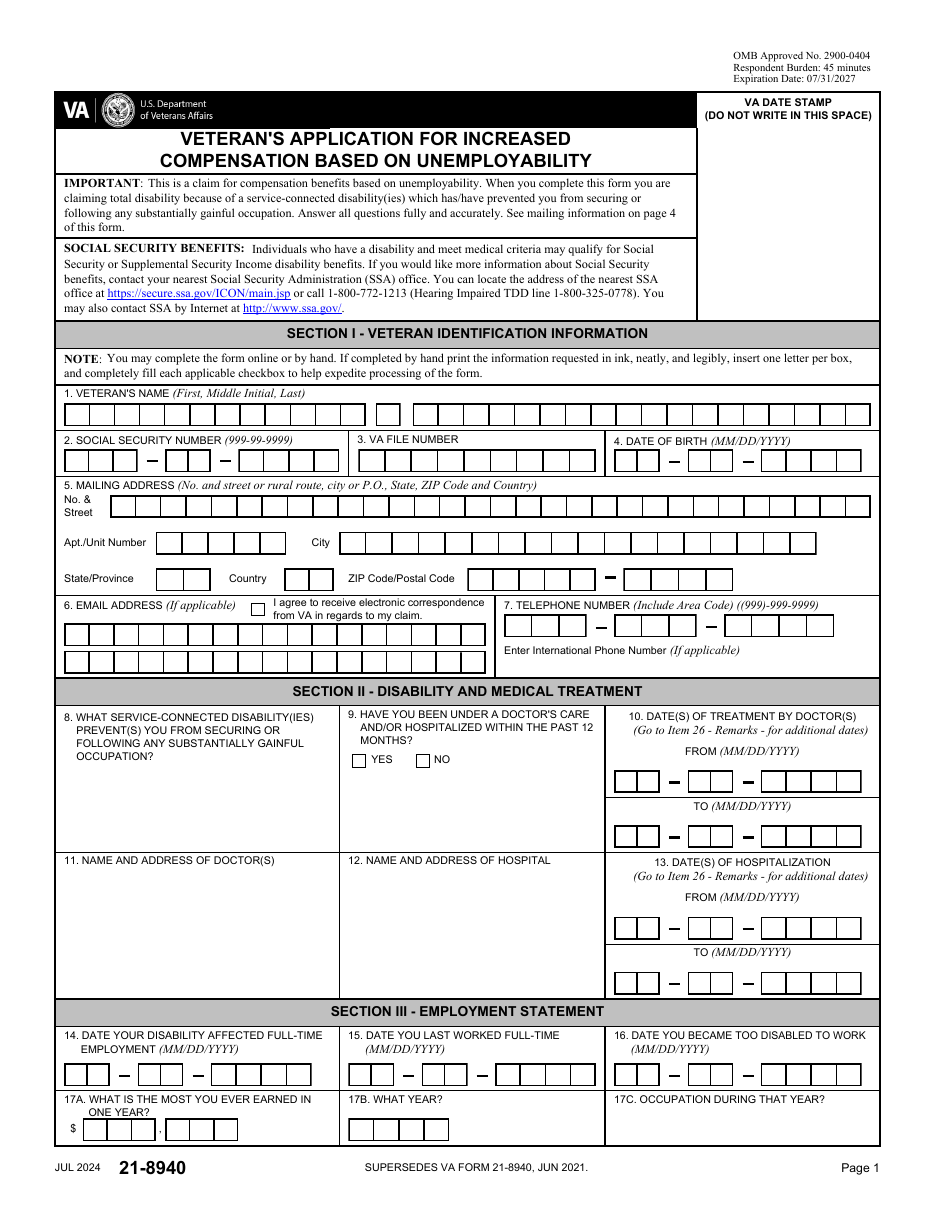
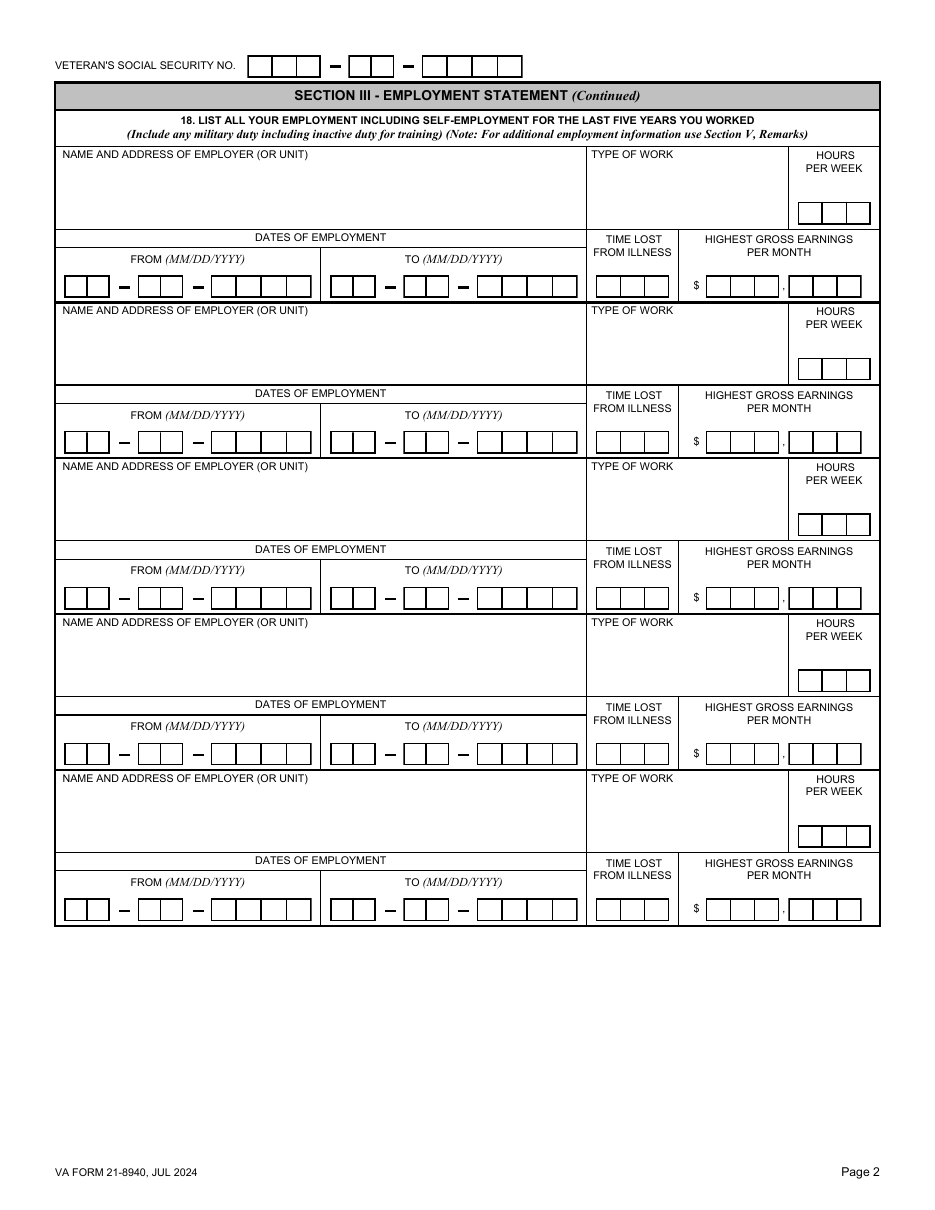
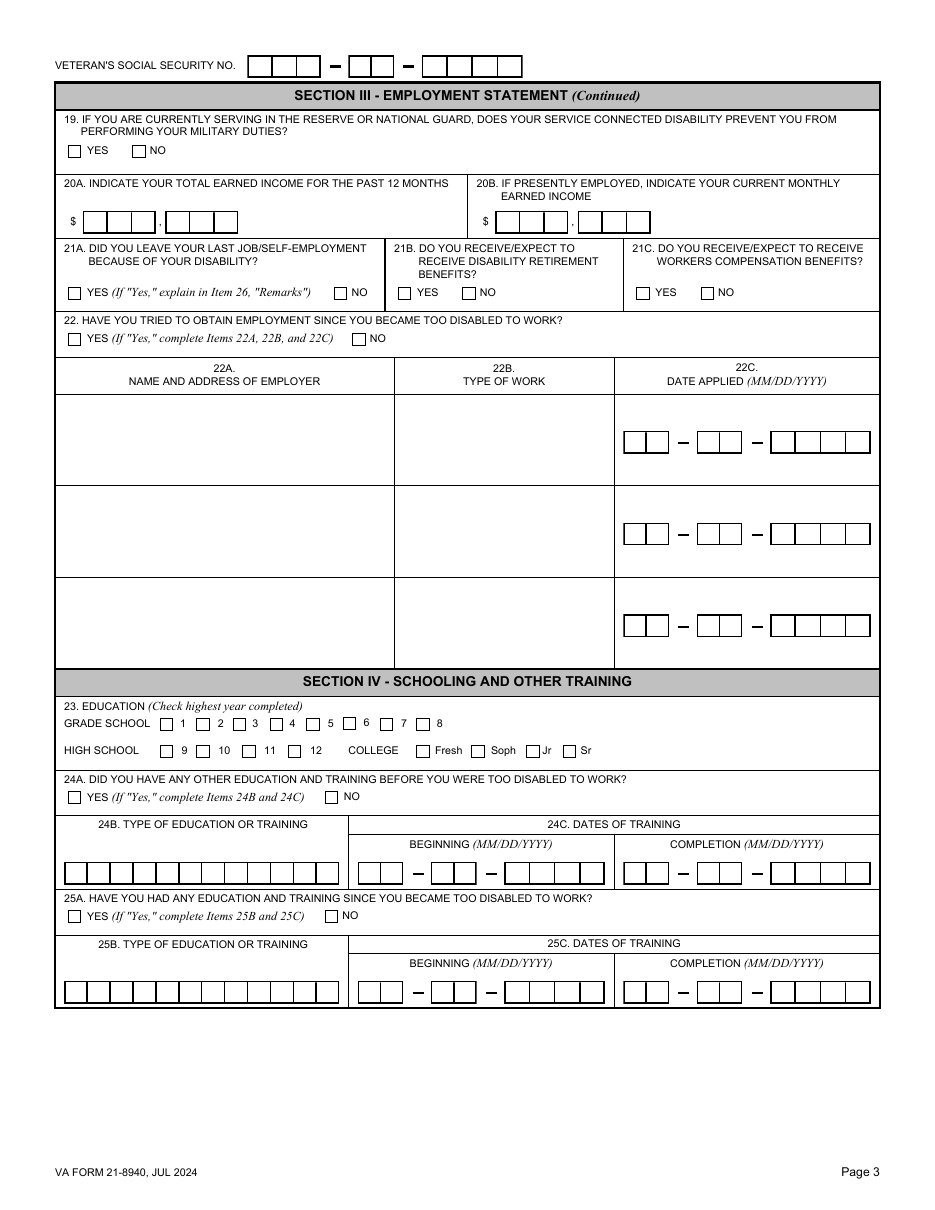
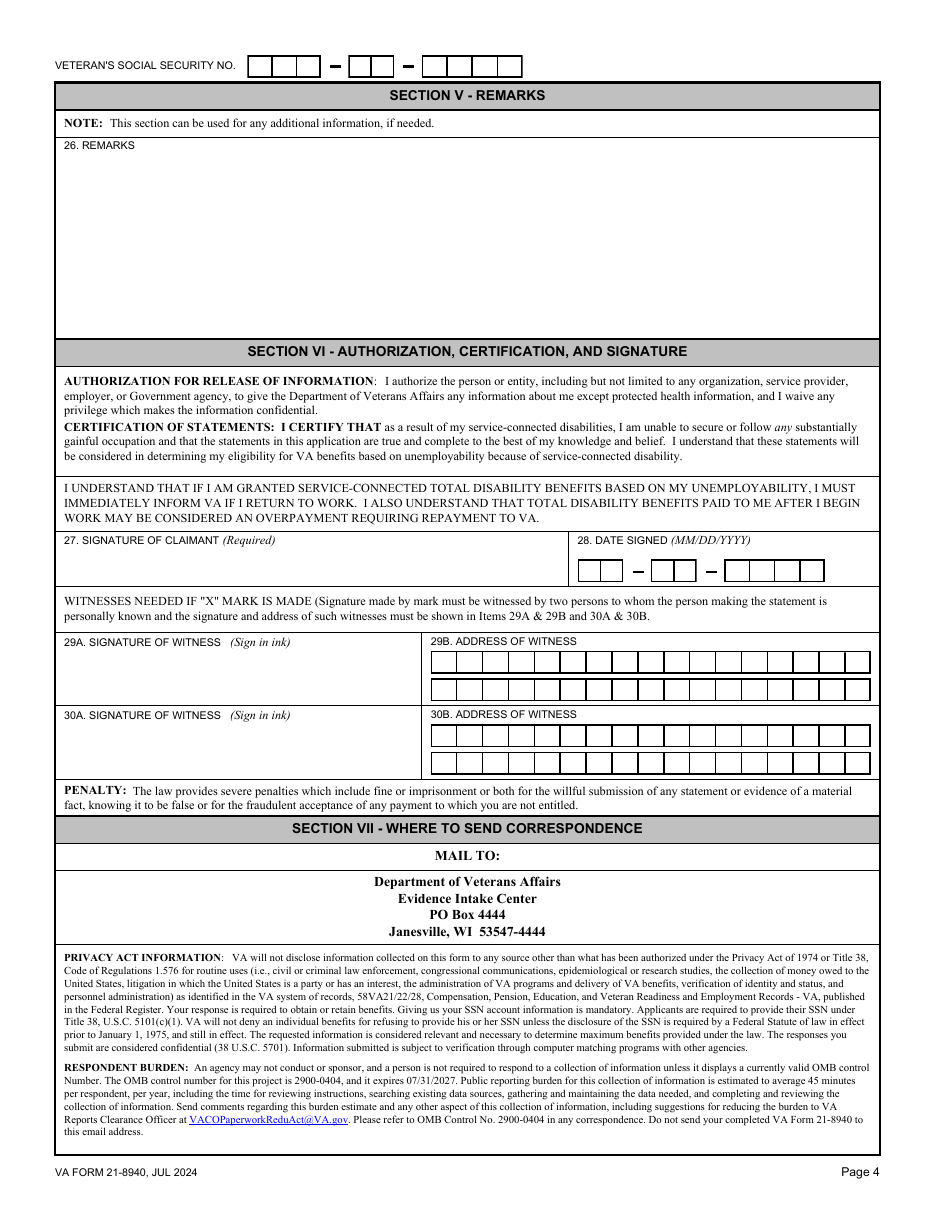
- Section I, items 1 to 7Your name, Social Security number, VA file number, date of birth, address, email and phone.
- Section II, items 8 to 13Which service-connected conditions keep you from working, and any doctor care or hospital stays in the past 12 months, with dates and addresses. Name at least one condition: if you don't, VA calls, then writes and waits 30 days before sending the claim for denial.
- Item 14The date your disability first affected full-time work.
- Item 15The date you last worked full time.
- Item 16The date you became too disabled to work. Items 14, 15 and 16 can be three different dates. Use Remarks to explain how they fit together.
- Item 17The most you ever earned in one year, the year and your job then.
- Item 18Every job for the last five years you worked, including self-employment and military duty (even inactive duty training): employer, type of work, hours per week, dates, time lost to illness and highest gross pay per month.
- Item 19Whether you're in the Guard or Reserve and how your conditions affect that duty.
- Items 20A and 20BYour total earned income for the past 12 months and your current monthly earned income.
- Items 21A to 21CWhether you left your last job because of your disability, and whether you get disability retirement or workers' compensation.
- Item 22Whether you've tried to get work since you became too disabled to work.
- Section IV, items 23 to 25Your highest grade completed, and any education or training before and since you became too disabled to work.
- Section V, item 26Remarks. Use it. Explain the dates, the tasks you can no longer do, any accommodations or special treatment at your last job, and why you left.
- Section VISign it yourself. VA won't accept a signature from a power of attorney. A signature by mark (X) needs two witnesses who know you. By signing, you agree to tell VA right away if you go back to work.
Sources: VA Form 21-8940 (July 2024) (opens in a new tab), M21-1 VIII.iv.3.B.1.
Fill out the 21-8940 online, free
Answer plain-language questions and download a completed PDF of the official form. Your answers stay in your browser until you download, which needs a free account.
Prefer paper? Download the official VA Form 21-8940 PDF (opens in a new tab) from VA. For a filled-in sample, see VA Form 21-8940 example: a filled-in work history and checklist.
VA Form 21-4192: what your employer fills out
VA Form 21-4192 asks your most recent employer to confirm your job, pay, time lost to your disability, any special concessions they made for you and why you left. The employer completes and signs it.
- VA sends it to the employers from your last year of work, with a copy to you. It gives them 15 days, then 15 more (M21-1 VIII.iv.3.B.3.c).
- VA tells veterans that getting the information is ultimately their responsibility, so give your employer a copy and follow up.
- VA can't deny TDIU only because an employer didn't send the form back.
- VA doesn't send it for self-employment or to a business that has closed. Self-employed veterans give VA a statement of their work, hours and time lost instead.
- For Guard or Reserve duty, your unit commander completes it.
More detail: VA Form 21-4192: how the employer fills it out, with an example, and what to send if your employer won't complete it. Official VA Form 21-4192 PDF (opens in a new tab) · Fill it out online.
Evidence that wins TDIU
The strongest TDIU evidence explains, in specific terms, what your service-connected conditions stop you from doing at work. Opinions from a vocational expert and from private medical providers stand out in the Board data.
When a final Board decision discussed a vocational expert or vocational assessment, TDIU was granted 79.0% of the time, against 61.4% without one. A private medical opinion went with 75.1% grants, against 62.7%.
Final TDIU grant rate when the decision discussed each kind of evidence
Final Board decisions only (granted or denied). This shows what went together in decided appeals, not proof that one piece of evidence caused a grant.
Source: Claim Raven analysis of final Board decisions on TDIU, February 2021 to April 2026.

Why Social Security records didn't line up with more grants. Social Security can count conditions VA can't, such as conditions that aren't service connected, and VA isn't bound by its decision (M21-1 VIII.iv.3.B.4.a). Its records can still help by showing how severe your service-connected conditions are. Read how to use Social Security records in a TDIU claim.
Education matters. When the decision noted a high school education or GED, 70.0% of final decisions were grants, against 62.9% when it noted a college degree. VA must weigh your education and training when it asks what work you could still do.
What to gather
TDIU evidence checklist
- VA Form 21-8940, signed by you
- VA Form 21-4192 from your last employer, or proof you asked for it
- Medical records from the past 12 months for each service-connected condition
- A statement from your treating provider describing what you can't do at work, for example how long you can sit or stand, what you can lift, and how your concentration or attendance is affected
- A vocational assessment, if you can get one (what they cost and what to ask)
- Your own statement about your last job and why you left (VA Form 21-4138)
- Statements from former coworkers, supervisors or family (VA Form 21-10210)
- Pay stubs, tax records or W-2s that show your earnings
- Proof of any special accommodations or a protected job (how to document it)
- Business records, if you were self-employed (what to send)
- Social Security disability decision and records, if you have them
Build a checklist for your own condition and claim with the free evidence checklist tool.
Why TDIU gets denied, and how to fix it
VA's manual lets raters deny TDIU for only three reasons: your service-connected conditions don't keep you from substantially gainful work, you are working at that level, or you didn't cooperate, for example by not returning VA Form 21-8940 (M21-1 VIII.iv.3.C.3.d).
At the Board, the first reason dominates. In 10,027 Board denials of TDIU, the findings said:
Why the Board denied TDIU
Share of Board TDIU denials whose findings gave each reason. A denial can give more than one.
2,922 denials stated their reason in other words and are not counted above. Source: Claim Raven analysis of Board decisions.
Why the Board sent TDIU back to VA
Share of TDIU remands whose remand discussion mentioned each reason. A remand can have more than one.
Based on 27,875 TDIU remands with a remand discussion. Source: Claim Raven analysis of Board decisions.
How to answer each reason
| If VA said | Send this |
|---|---|
| Your conditions don't prevent all work | A provider statement on specific limits, a vocational assessment that applies those limits to jobs you could actually do with your education and history, and statements from people who saw you at work. |
| You're working | Proof your earnings were at or below the poverty threshold, or that the job was protected (family business, sheltered work, special treatment). See working while on TDIU. |
| You didn't meet the rating thresholds | Ask VA to send the claim for extraschedular review under 38 CFR 4.16(b), and check whether some of your conditions should count as one (common cause, one body system, both arms or legs). |
| You didn't return the 21-8940 | Fill out and sign the 21-8940 and file a Supplemental Claim with it. |
You have one year from the decision to choose a Supplemental Claim, a Higher-Level Review or a Board appeal. Read why TDIU claims are denied: match the reason to the work evidence, and compare your options in the Appeals Advisor.
Can you work while getting TDIU?
Yes, within limits. Marginal work doesn't count against TDIU. VA treats work as marginal when your earned income for the year is at or below the Census poverty threshold for one person, which was $16,749 for 2025 for a person under 65.
- The income line. The rule names the Census Bureau's poverty threshold for one person (38 CFR 4.16(a)), not the HHS poverty guidelines many websites quote. The 2025 figure is $16,749 for one person under 65 (Census Bureau (opens in a new tab)). The rule doesn't say which age row VA uses; the Court used the under-65 figure in Faust v. West (opens in a new tab).
- Protected work can pay more. A job shielded from normal competition because of your service-connected conditions, such as a family business, sheltered workshop or a boss who lets you miss work during flare-ups, can count as marginal even above the threshold. The Court defined it in 2024 (LaBruzza and McBride v. McDonough (opens in a new tab)). A standard ADA accommodation alone doesn't make a job protected (M21-1 VIII.iv.3.A.2.e).
- VA's work therapy pay doesn't count. Money from VA's Compensated Work Therapy program isn't income for TDIU (M21-1 VIII.iv.3.A.2.c).
- The 12-month rule. If you start substantially gainful work, VA can't reduce TDIU for that reason until you've kept the job for 12 consecutive months, and it must prove you're employable by clear and convincing evidence (38 CFR 3.343(c)).
- Tell VA. The 21-8940 says you must tell VA right away if you go back to work. Payments after that can become a debt.
- How VA checks. VA matches wage data with Social Security every year. If the match shows earnings above the poverty line, VA sends VA Form 21-4140 and you have 65 days to respond (VA.gov (opens in a new tab)). VA stops this monitoring after 20 continuous years of TDIU (M21-1 VIII.iv.3.D).
TDIU vs 100% P&T: which is better?
Both pay the same 100% rate. A 100% schedular rating lets you work without limits. TDIU limits you to marginal work. "Permanent and total" (P&T) is a separate finding that can attach to either one, and it is what opens DEA and CHAMPVA for your family.
| Benefit | TDIU | TDIU found permanent | 100% schedular P&T |
|---|---|---|---|
| Monthly pay | 100% rate | 100% rate | 100% rate |
| Your rating on paper | Stays the same | Stays the same | 100% |
| Can you work? | Marginal work only | Marginal work only | Yes, no income limit |
| VA dental care (Class IV) | Yes | Yes | Yes |
| DEA (Chapter 35) for family | No | Yes | Yes |
| CHAMPVA for family | No | Yes | Yes |
| Future exams | Possible | Generally none | Generally none |
When VA finds your TDIU permanent, its manual tells raters to award DEA at the same time. If you later get a 100% schedular rating, VA keeps the TDIU grant on record and pays the greater benefit (M21-1 VIII.iv.3.C.3.h).
Is TDIU permanent? Can VA take it away?
Not automatically. VA can grant TDIU as permanent, as total but not permanent, or even for a temporary period. Several rules protect it once you have it.
- No reduction just for trying to work. VA needs clear and convincing evidence that you can actually hold a job, and 12 straight months of substantially gainful work, before it can reduce for that reason (38 CFR 3.343(c)).
- Notice first. VA must propose any reduction, explain why and give you 60 days to send evidence (38 CFR 3.105(e)).
- Age 55. VA generally doesn't schedule routine re-exams for veterans over 55 (38 CFR 3.327(b)(2)(iv)).
- 20 years. A rating held for 20 or more years can't be reduced except for fraud (38 CFR 3.951(b)), and VA stops income monitoring after 20 continuous years of TDIU.
- If you miss the form. If you don't return VA Form 21-4140 when asked, VA reduces you to your schedular rating, but restores TDIU from the reduction date if you send proof of continued unemployability within a year (M21-1 VIII.iv.3.D.2.a).
When veterans appealed a TDIU reduction or termination to the Board, the Board ruled for the veteran in 60.7% of 219 decided appeals.
Can you get TDIU and Social Security disability?
Yes. Social Security disability (SSDI) and VA compensation don't reduce each other, so you can receive both, but you apply for each separately (Social Security Administration (opens in a new tab)).
The two programs use different rules. Social Security looks at all your conditions and your age; VA looks only at service-connected conditions and can't consider age. That is why an SSDI award helps but doesn't decide a TDIU claim. VA gets your Social Security records when they could help, and its manual calls an SSDI award "a factor to weigh" (M21-1 VIII.iv.3.C.1.e). The 21-8940 itself reminds you that you may qualify for SSDI. More: SSDI and TDIU: using Social Security records in a VA claim.
How long does a TDIU claim take?
VA doesn't publish a processing time for TDIU claims. Three things commonly add time: waiting on VA Form 21-4192 from employers (up to 30 days), an exam, and an extraschedular referral to VA's central office.
Appeals take far longer. For TDIU appeals under the current Board system, the median time from the Board appeal form to the decision was 742 days, and half of appeals took between 265 and 1,234 days (24,624 appeals). Direct review was the fastest Board docket. If you have new evidence, a Supplemental Claim at VA is usually quicker than the Board; see VA's current times on decision review statistics.
How far back does TDIU pay? Effective dates and back pay
TDIU usually starts on the later of the date VA got your claim and the date you became unable to work. It can reach back up to one year before your claim if the evidence shows you became unemployable in that year (38 CFR 3.400(o)(2)).
- The one-year look-back. VA checks whether it's "factually ascertainable" that you met the TDIU criteria in the year before VA received the claim (M21-1 V.ii.4.A.5.c). Evidence dated in that year, such as a job loss or a doctor's note on work limits, can move your start date earlier.
- An intent to file holds your date. Filing an intent to file gives you a year to complete the claim.
- A claim for a higher rating can carry TDIU. Because TDIU is part of a claim for a higher rating when the record raises it (Rice), the start date can tie back to that claim.
- It can't start before service connection. TDIU can't begin before the effective date of the condition it rests on.
- Check VA's math. VA's Inspector General estimated that 34% of the TDIU grants in its review (claims completed May 2022 to April 2023) had the wrong effective date (VA OIG (opens in a new tab)).
At the Board, appeals over the TDIU start date went the veteran's way in 46.3% of 6,523 decided appeals. Estimate what an earlier date is worth with the back pay calculator, and read the effective dates guide.
Is there an age limit for TDIU?
No. VA can't consider your age when it decides TDIU (38 CFR 4.19), and there is no age cutoff in current law.
A bill introduced in June 2026, H.R. 9135 (opens in a new tab), would stop TDIU at age 67 for veterans first awarded it on or after December 31, 2026. As of October 2, 2026 it sits in a House subcommittee with no cosponsors and is not law. The Congressional Budget Office has listed a similar idea as a budget option (CBO (opens in a new tab)), which is not a proposal.
In the Board data, veterans whose service began earlier won slightly more often in final decisions (by year service began: before 1964, 65.0%; 1964 to 1975 (vietnam era), 66.6%; 1976 to 1990, 62.8%; 1991 to 2001 (gulf war era), 58.9%; 2002 or later, 58.4%). That likely reflects longer medical histories, not age itself.
Questions veterans ask about TDIU
How hard is it to get TDIU?
VA doesn't publish an approval rate. At the Board of Veterans' Appeals, 64.0% of final decisions on TDIU were grants, based on 27,823 decisions from February 2021 to April 2026. About half of all Board rulings on TDIU sent the issue back to VA instead of deciding it.
How much does 100% TDIU pay a month?
$3,938.58 a month for a veteran alone and $4,158.17 with a spouse under VA's 2026 rates. Dependents add more.
How far back does TDIU back pay go?
Usually to the later of your claim date and the date you became unable to work. It can go back up to one year before your claim if evidence shows you became unemployable in that year, and an intent to file holds your date while you finish the claim.
Which is better, TDIU or 100% P&T?
They pay the same. A 100% schedular rating lets you work without an income limit; TDIU limits you to marginal work. A permanent and total finding is what opens DEA and CHAMPVA for your family, and it can attach to TDIU too.
Is TDIU the same as being rated 100%?
No. TDIU pays the 100% rate, but your ratings stay the same on paper, and you must stay out of substantially gainful work.
Can I work while on TDIU?
Yes, if the work is marginal: earned income at or below the Census poverty threshold for one person ($16,749 for 2025, under 65), or a protected job. You must tell VA if you go back to work.
Can I get TDIU and Social Security disability at the same time?
Yes. They don't reduce each other, but you apply for each separately.
Does TDIU require a C&P exam?
Not always. VA's manual says an exam isn't automatically required for TDIU. When VA orders one, the examiner describes how your conditions limit work; the rater decides whether you're unemployable.
What are the chances of getting TDIU for PTSD?
In Board appeals where a mental health condition such as PTSD was also on the appeal, 67.3% of final TDIU decisions were grants (7,812 decisions). Mental health conditions were on 31.3% of TDIU appeals, more than any other kind.
How long does TDIU take?
VA doesn't publish a TDIU processing time. At the Board, the median TDIU appeal under the current system took 742 days from appeal to decision.
Is there an age limit for TDIU?
No. VA can't consider age for TDIU, and no age limit is law. A 2026 House bill would add one for new awards at 67, but it has not moved out of subcommittee.
Get help with your TDIU claim
You can file TDIU yourself with the forms and evidence above. If you want guidance at every step without giving up part of your back pay, Pathfinder is built for that.
Want free representation? A Veterans Service Organization can file for you at no cost. Prefer a lawyer? Find a VA-accredited attorney.
More TDIU guides
- VA Form 21-8940 example: a filled-in work history and checklist
- VA Form 21-4192: how the employer fills it out
- Employer won't complete VA Form 21-4192?
- TDIU vocational assessment cost
- TDIU and self-employment records
- TDIU and a protected work environment
- TDIU marginal employment and the poverty threshold
- SSDI and TDIU
- Why TDIU claims are denied
- TDIU approval rate: the full Board study
- TDIU in the VA glossary
- How to ask for a higher rating
Sources and method
Board data. Claim Raven read the text of every Board of Veterans' Appeals decision in its 501,131-decision library that mentions TDIU (94,152 decisions, February 2021 to April 2026) and kept the 61,746 that ruled on whether the veteran was entitled to TDIU. Each outcome comes from the order at the top of the decision. Checked against outcome labels extracted separately for an earlier subset, the two agreed on 99.5% of 369 decisions. Grant rates count partial grants as grants and leave dismissed appeals out. Each row is a decision, and one veteran can have more than one. Groups under 100 decisions aren't shown. Full method: TDIU approval rate study.
Rules and forms (checked October 2, 2026):
- 38 CFR 4.16, 4.18, 4.19, 3.340, 3.341, 3.343, 3.400, 3.327, 3.951, 14.636
- M21-1 VIII.iv.3.A, VIII.iv.3.B, VIII.iv.3.C, VIII.iv.3.D and V.ii.4.A
- VA Form 21-8940 (July 2024) (opens in a new tab), VA Form 21-4192 (August 2024) (opens in a new tab), VA Form 21-4140 (August 2024) (opens in a new tab)
- VA.gov: Individual Unemployability (opens in a new tab) and verifying your status (opens in a new tab)
- VA compensation rates, 2026 (opens in a new tab)
- Census Bureau poverty thresholds, 2025 (opens in a new tab)
- VA FY 2027 budget submission, Volume 3 (TDIU recipients) (opens in a new tab)
- VA Office of Inspector General, report 23-01772-162 (2024) (opens in a new tab)
- Court decisions: Rice v. Shinseki (2009) (opens in a new tab), Ray v. Wilkie (2019) (opens in a new tab), Faust v. West (2000) (opens in a new tab), Ortiz-Valles v. McDonald (2016) (opens in a new tab), LaBruzza and McBride v. McDonough (2024) (opens in a new tab)
Cite this page
Claim Raven. TDIU: requirements, pay and Board outcomes. Board data February 2021 to April 2026. https://claimraven.com/tdiu
Claim Raven explains VA rules in plain English so you can work your own claim. It is not legal advice, and Claim Raven is not affiliated with the Department of Veterans Affairs. Board outcomes describe appeals that reached the Board; they don't predict any one claim.