
Case Citation: 23000410 | Decision Year: 2023 | Judge: M. Donohue
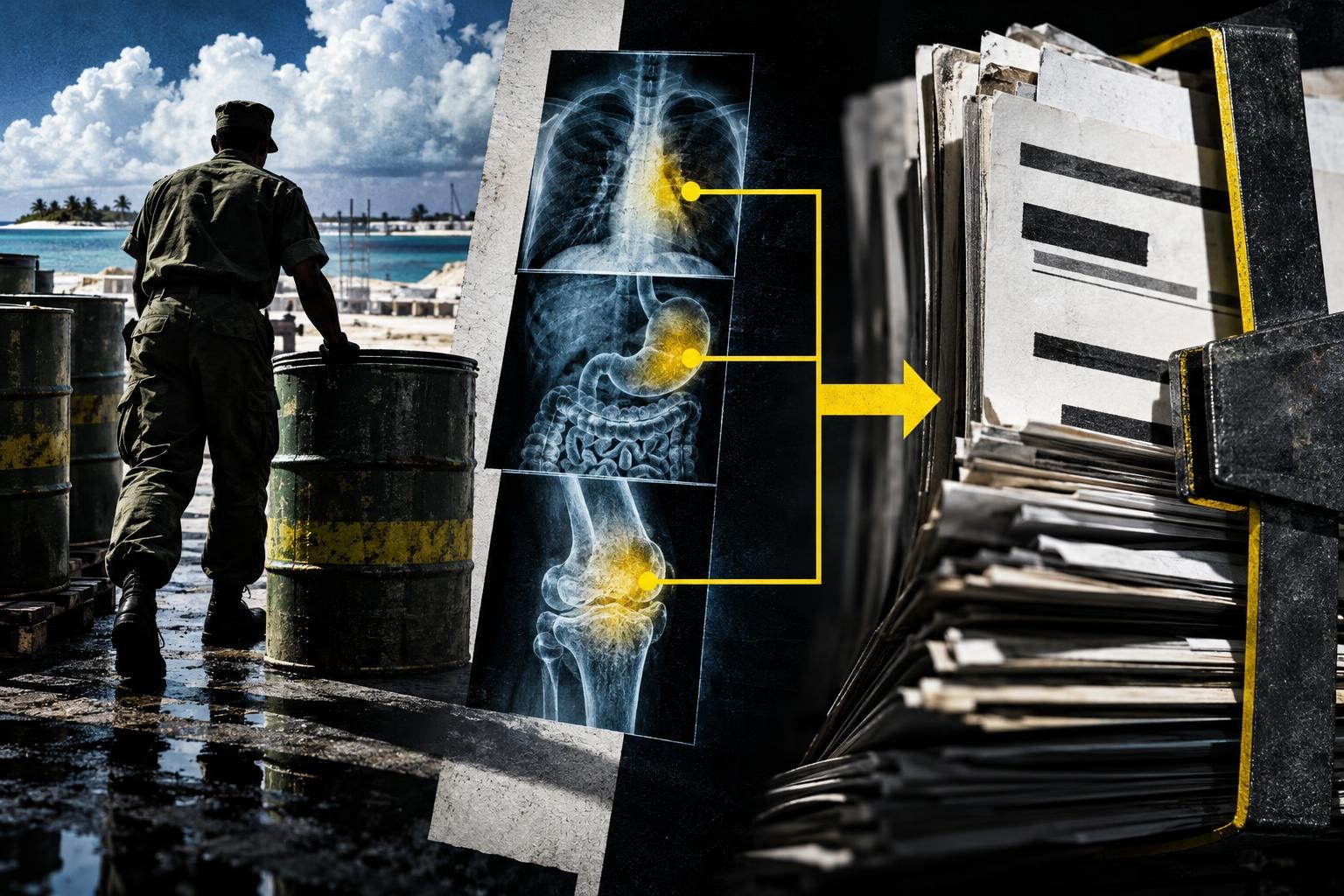
An Army storage supplyman spent part of his career on Johnston Atoll, a tiny island in the Pacific that the federal government used as a chemical weapons stockpile and an Agent Orange storage site through the 1970s. He didn't fly missions. He didn't kick in doors. He stored drums. Daily. For years.
Decades after he separated, he filed for macular degeneration, cataracts, and sleep apnea. The VA had nothing in his file connecting any of those conditions to a recognized in-service event. He paid for one private medical opinion, written by a physician willing to spell out the inflammatory pathway from toxicant exposure to metabolic syndrome to downstream organ damage. The Board granted all three claims in a single decision.
This is what one well-built nexus letter can do across multiple claims when the in-service exposure is concrete and the medical theory is unified.
The Hook
The veteran served on active duty from June 1976 to September 1995. Nineteen years, Army, with a military occupational specialty of storage supplyman and storage specialist. His DD-214 documented an overseas assignment in Hawaii. His service treatment records placed him at Johnston Island in June 1975 (the records pre-date his June 1976 active service start, which the Board treated as part of his cumulative service history at that location).
Why does Johnston Island matter? Because the VA Adjudication Manual itself, M21-1, VIII.i.1.A.5.b, documents that Agent Orange was stored on Johnston Atoll between April 1972 and September 1977. The entire inventory was screened for leaks daily, with fresh spillage absorbed and leaking drums redrummed on a weekly basis. The Sergeant First Class Heath Robinson Honoring our Promise to Address Comprehensive Toxics Act of 2022 (the PACT Act) created a presumption of tactical herbicide agent exposure for any veteran who served on Johnston Atoll between January 1, 1972 and September 30, 1977.
The veteran's MOS placed him in the storage facility. His own testimony at the December 2020 Board hearing put him around chemicals daily. The VA Manual and the PACT Act gave him a documented exposure site and a presumption. That's a complete in-service event component, built from VA's own paperwork.
But exposure alone doesn't grant claims. You still need the third Shedden element: a causal relationship between the current disability and the in-service event. That's where most cases stall. The C&P examiners often won't connect the dots, the treating physicians won't write nexus letters, and the veteran is left with a strong story and no medical bridge.
This veteran solved that with one document: a January 2021 private medical opinion (an Independent Medical Examination, or IME) that connected his toxicant exposure to a metabolic syndrome diagnosis and then connected the metabolic syndrome to three different organ-system manifestations. One opinion, three grants.
What Happened (The Quick Version)
- Service: Army, June 1976 to September 1995. MOS: storage supplyman, then storage specialist. Overseas assignment in Hawaii. Service records placing him at Johnston Island.
- Claimed conditions in this appeal: Macular degeneration, cataracts, sleep apnea, hypokalemia, hammertoe, left knee (secondary to right knee), increased ratings on bilateral flat feet, right knee, low back, and hypertension, earlier effective date on flat feet, TDIU. Plus two reopen attempts on hypercholesterolemia and triglycerides.
- Already service-connected before this decision: Hypertension, bilateral foot disability, low back disability, right knee disability.
- Outcome at the Board:
- Granted: Macular degeneration, cataracts, sleep apnea.
- Denied: Hypokalemia (laboratory finding, not a disability). Reopens of hypercholesterolemia and triglycerides denied (same reason: lab findings, not disabilities).
- Remanded: Hammertoe, left knee secondary, increased ratings on flat feet, right knee, low back, and hypertension, earlier effective date on flat feet, and TDIU.
- Dismissed: Left hand (withdrawn at the December 2020 hearing).
- In-service exposure basis: Johnston Atoll, documented Agent Orange storage site between April 1972 and September 1977. PACT Act presumption of tactical herbicide agent exposure. M21-1 corroboration. Veteran's hearing testimony about daily chemical handling.
- Nexus theory: Direct service connection via toxicant exposure leading to metabolic syndrome, with macular degeneration, cataracts, and sleep apnea as downstream manifestations.
- Key piece of evidence: January 2021 private medical opinion (IME).
- C&P exam history: December 2018 VA examination confirmed diagnoses of macular degeneration and nuclear sclerosis cataracts. September 2018 private sleep study confirmed severe obstructive sleep apnea.
Why This Matters to You
If you served at a documented toxic exposure site and you have current conditions that no examiner has tied back to that exposure, this case is the answer to the question you've been asking. The Board accepted a single private medical opinion that connected one inflammatory mechanism to three separate organ systems, and it granted all three claims. What you'll walk away with from this breakdown is a clear sense of when a unified nexus theory is worth pursuing, what an IME needs to actually say to carry that weight, and why the in-service event component is sometimes easier to prove than veterans think.
Why This Case Matters
- A unified pathway nexus letter can carry multiple claims at once. One IME explained how toxicant exposure produced metabolic syndrome, which then produced eye degeneration and sleep apnea. Three grants from one document.
- The PACT Act expanded presumptions far beyond Vietnam soil. Johnston Atoll is one of those expanded sites. If your service touched any of the new presumption locations, the in-service event component may already be established by statute.
- The VA Adjudication Manual (M21-1) is evidence you can cite. The Board quoted the M21-1 entry on Johnston Atoll storage operations as corroboration. The Manual is not just internal guidance, it can support your factual record.
- Lab findings are not disabilities. The same decision granted three conditions and denied three lab values (hypokalemia, hypercholesterolemia, triglycerides). Knowing the difference matters before you file.
What the Board Said
On the in-service exposure finding:
Given the Veteran's MOS, his testimony, and his location in service, the Board finds that the evidence of record supports the Veteran's claim that he was exposed to chemicals while working in a storage facility during service. Moreover, the Sergeant First Class Heath Robinson Honoring our Promise to Address Comprehensive Toxics Act of 2022 provides that tactical herbicide agent exposure is presumed for veterans who served on Johnston Atoll during the period beginning on January 1, 1972 and ending on September 30, 1977. Thus, the first two elements of service connection have been established and the question becomes whether the current disabilities are related to service.
Three sources stacked: the MOS, the testimony, and the statute. The Board moves past the in-service event question and explicitly narrows the remaining issue to nexus.
On the private medical opinion that carried the nexus:
The physician noted that the Veteran "was more likely than not exposed to multiple toxicants including high molecular weight toxicants, volatile organic toxicants, and insecticides." He added that "it is also more likely than not that the gastrointestinal dysbiosis was present with the development of colonic adenomas," noting that this "disrupts the protective features and functions of the bowel with disruption of junctional barriers for the basal layer of the gastrointestinal tract," leading to increased toxicant exposure, and causing multiple organs to be exposed to "increased levels of proinflammatory cytokines and inflammasomes." This was explained to result in the development of metabolic syndrome, to include degenerative changes of the eye, to include macular degeneration and cataracts.
Read that paragraph and notice the structure. The physician didn't just say "exposure caused macular degeneration." He built a chain: exposure to specific classes of toxicants, a mechanism (gastrointestinal dysbiosis disrupting barrier function), an intermediate finding (proinflammatory cytokines and inflammasomes), a named syndrome (metabolic syndrome), and then the specific endpoints (degenerative eye changes, sleep apnea). Each step is medically articulable. That's what makes the opinion withstand scrutiny.
On the standard of proof and tie:
Upon review of the record, the Board finds the evidence indicates that the Veteran's macular degeneration and cataracts are related to his service. Accordingly, after resolving all doubt in favor of the Veteran, the Board finds that service connection for macular degeneration and cataracts are warranted.
The reasonable doubt doctrine carried the close call. When the evidence is in approximate balance, the tie goes to the veteran. The Board cited the rule explicitly.
On why hypokalemia was denied even though the same physician's opinion was in the file:
Hypokalemia is a laboratory finding and neither a disease nor disability as contemplated by the Department of Veterans Affairs (VA).
One sentence, fatal to the claim. No matter how strong the exposure evidence or how persuasive the nexus theory, a lab value is not a compensable disability. This is the same reason the reopens of hypercholesterolemia and triglycerides failed. Three different lab findings, three identical denials, sitting alongside three grants in the same decision.
The First Precedent: Shedden v. Principi (Fed. Cir. 2004). The Three Elements of Direct Service Connection
Shedden v. Principi, 381 F.3d 1163 (Fed. Cir. 2004) is the case that defines what you have to prove for a direct service connection claim. The three elements: (1) a current disability, (2) in-service incurrence or aggravation of a disease or injury, and (3) a causal relationship between the current disability and the in-service disease or injury.
The Board worked through Shedden methodically in this case. Element one was satisfied by the December 2018 VA examination diagnosing macular degeneration and nuclear sclerosis cataracts, and by the September 2018 private sleep study diagnosing severe obstructive sleep apnea. Element two was satisfied by the combination of the veteran's MOS, his Board hearing testimony, the M21-1 documentation of Agent Orange storage at Johnston Atoll, and the PACT Act presumption. Element three was satisfied by the January 2021 IME.
The practical lesson: when you build a claim, build it explicitly around the three Shedden elements. Diagnosis. In-service event. Nexus. If any one element is missing, the claim fails. If all three are present and credible, the claim usually wins.
The Second Precedent: Holton v. Shinseki (Fed. Cir. 2009). What "Related to Service" Means
Holton v. Shinseki, 557 F.3d 1363 (Fed. Cir. 2009) reinforces the basic causal-relationship requirement under the direct service connection framework. The Board cited Holton twice in this decision, once for the macular degeneration and cataracts grants, once for the sleep apnea grant. The case stands for the proposition that the disability must be shown to be "related to" service, which is the third Shedden element restated.
What's worth understanding about Holton in this case is the breadth of the "related to service" standard. The veteran did not have to prove that his service caused macular degeneration in a directly observable, immediate way. He had to show, by at least an approximate balance of evidence, that the chain from his service exposure to his current disability was medically plausible. The IME provided that chain. Holton accepted the chain. The grant followed.
The Third Authority: The PACT Act and the M21-1 Manual. Johnston Atoll Becomes a Recognized Exposure Site
This is not a court precedent, but it's the most important legal development in this case, and it's worth treating with the same seriousness as a case citation.
The Sergeant First Class Heath Robinson Honoring our Promise to Address Comprehensive Toxics Act of 2022, signed into law in August 2022, dramatically expanded the list of recognized toxic exposure sites and qualifying conditions for VA presumptive service connection. Johnston Atoll is one of those newly recognized sites. Any veteran who served there between January 1, 1972 and September 30, 1977 now gets a presumption of tactical herbicide agent exposure.
That presumption is gold. It transforms the in-service event question from a contested factual dispute into a statutory given. The Board doesn't have to weigh the veteran's testimony against the absence of contemporaneous documentation. The Board just has to confirm the service dates and the location.
The M21-1 Manual entry at VIII.i.1.A.5.b backs this up with specific operational detail: Agent Orange was stored on Johnston Atoll for the relevant period, the inventory was inspected daily, and spillage and leaking drums were routine enough that VA documented the response procedures. When you cite the Manual, you're not citing internal guidance, you're citing VA's own admissions about what was happening at the site.
If you served at any of the newly recognized PACT Act locations (Johnston Atoll, Thailand bases under specific conditions, certain Korean DMZ areas, Eglin AFB, the C-123 aircraft contexts, the Karshi-Khanabad base in Uzbekistan, and many others), look up the specific dates and the specific covered conditions before you do anything else.
The IME That Did the Work: Why This Opinion Survived
The Board did not cite any examiner failures or remand on inadequate exam grounds for the granted claims. What it did was accept a private medical opinion that VA's own examiners had not provided. The IME succeeded because of how it was constructed. Let me walk through what made it work.
- It named specific classes of toxicants. Not "chemicals," not "things he was exposed to," but "high molecular weight toxicants, volatile organic toxicants, and insecticides." That specificity matches the M21-1 description of the operational reality at Johnston Atoll (Agent Orange and other herbicides, insecticides, industrial chemicals associated with storage operations).
- It articulated a mechanism. Gastrointestinal dysbiosis with disruption of junctional barriers, leading to increased systemic toxicant exposure. This is not magic words, this is a coherent biological pathway that an opposing examiner would have to engage with on its merits.
- It named an intermediate finding. Proinflammatory cytokines and inflammasomes. These are measurable biological markers, not vague hand-waving. An opposing opinion would have to address them.
- It named a recognized syndrome. Metabolic syndrome is a defined clinical entity. By routing the causation through metabolic syndrome, the physician created a single pathophysiological basis for multiple downstream conditions.
- It connected the syndrome to the specific endpoints. Degenerative changes of the eye (macular degeneration and cataracts) and sleep apnea were all named explicitly as manifestations of the same underlying inflammatory process.
- It used the "more likely than not" language. Twice. That's the at-least-as-likely-as-not standard VA requires, and the physician didn't dance around it.
What it did NOT do, importantly, is overreach. The same physician's opinion was in the file for hypokalemia, hypercholesterolemia, and triglycerides. The Board denied all three of those because they're lab findings, not disabilities. The IME could not bridge that gap, because no IME can make a lab value into a compensable condition. The opinion only worked where the underlying claim was structurally sound.
If your case looks anything like this one, the next part is what matters most. Not the case law. The list of things to do in your file.
Lesson #1: A Unified Pathway IME Is the Highest-Leverage Document You Can Get
I want to be careful with that word "leverage" here, so let me say it differently: a unified pathway IME is the single most efficient piece of evidence in this veteran's entire file. He paid for one opinion. That opinion did the nexus work for three separate claims. The cost-per-claim ratio on that document is impossible to beat with any other type of evidence.
The structure that made it work is reproducible. The physician identified a single in-service exposure, named a single biological mechanism, named a recognized syndrome as the intermediate state, and then connected that syndrome to multiple downstream conditions. If you have multiple claimed conditions that could plausibly share a common etiology (a single toxic exposure, a single traumatic event, a single underlying service-connected condition), look for a physician who can write one opinion that addresses all of them through a shared mechanism.
This is especially powerful for toxic exposure cases. The science on systemic inflammation, oxidative stress, and endocrine disruption is well-developed enough that a single exposure history can plausibly connect to cardiovascular, neurological, ophthalmologic, and pulmonary conditions. One IME, multiple claims.
Lesson #2: The PACT Act Did Not Just Expand Vietnam Presumptions
A lot of veterans I talk to think the PACT Act was a Vietnam veterans' bill. It wasn't. It was a comprehensive toxic exposure bill that touched dozens of locations across multiple eras. Johnston Atoll, the Karshi-Khanabad base, certain Thailand bases, Eglin AFB, sites associated with C-123 aircraft, locations along the Korean DMZ, sites in the Persian Gulf and Southwest Asia, burn pit exposures across the post-9/11 era, and many others.
If you served anywhere with documented toxic operations (chemical storage, fuel handling, asbestos remediation, radiation cleanup, pesticide spraying, industrial waste sites), look up whether your specific service dates and location are covered by the PACT Act or by any other presumption. The list keeps expanding. What was not presumed two years ago may be presumed today.
The mechanical difference between presumed exposure and contested exposure is enormous. With a presumption, the in-service event element is essentially established by statute. Without a presumption, you have to prove the exposure through service records, unit histories, MOS evidence, lay statements, and any other documentation you can pull together.
Lesson #3: The M21-1 Adjudication Manual Is Evidence
VA's own Adjudication Manual, M21-1, is publicly available. It contains detailed operational information about specific exposure sites, the types of chemicals stored or used, the dates of operations, and the response procedures VA recognized at the time. When the Manual contains entries favorable to your claim, you can and should cite them directly.
In this case, the Board quoted the M21-1 entry on Johnston Atoll storage operations as part of its findings on the in-service event element. The Manual corroborated the veteran's testimony and the statutory presumption. The Manual is essentially VA admitting, in writing, what happened at specific locations.
When you file or appeal, look up the M21-1 entries relevant to your service location, MOS, and claimed conditions. If a favorable entry exists, cite it with the specific section number (here, M21-1, VIII.i.1.A.5.b). Quote the helpful language directly. Make the Board read VA's own description of the operational reality.
Lesson #4: Lab Findings Are Not Disabilities, and That Distinction Will Sink Claims
This same decision granted macular degeneration, cataracts, and sleep apnea while denying hypokalemia, hypercholesterolemia, and triglycerides. The IME's exposure-and-inflammation theory was equally available to all six conditions. Why did three win and three lose?
Because three of them are recognized clinical conditions with diagnostic criteria, functional impairment implications, and rating schedule entries. The other three are laboratory values. A potassium reading below the normal range is a lab finding. An LDL cholesterol reading above the normal range is a lab finding. Elevated triglycerides is a lab finding. None of these are "diseases or disabilities as contemplated by the Department of Veterans Affairs," in the Board's words.
Before you file a claim, ask yourself: is this a disease or condition that produces functional impairment, or is this a number on a lab report? If it's just a number, you cannot win, no matter how strong your exposure evidence or your nexus letter. You can sometimes claim the downstream disease the lab value reflects (cardiovascular disease for cholesterol, certain endocrine conditions for potassium imbalance), but you cannot claim the lab value itself.
Lesson #5: An MOS Is In-Service Event Evidence
The veteran's MOS as a storage supplyman and storage specialist did real work in this decision. Combined with his DD-214 showing the Hawaii assignment and the service treatment records placing him at Johnston Island, the MOS gave the Board a coherent picture of what he was doing day-to-day during the relevant period.
MOS evidence is often underused in toxic exposure claims. If your job title placed you in proximity to known hazards (motor pool, fuel handling, ordnance disposal, aircraft maintenance, supply and storage, medical waste handling, dental laboratories with mercury, communications work with PCBs, water treatment, you can extend this list significantly), that MOS is a starting point for the in-service event argument.
Pair the MOS with unit history records, deployment records, base histories, and the M21-1 entries for the specific locations you served, and you can build a documented exposure record even without a contemporaneous medical entry showing the exposure event.
Lesson #6: A Grant on Direct Service Connection Often Comes With a Remand Tail
Look at what else happened in this decision. Three grants on direct service connection. Six remands. The remands cover the increased ratings on the conditions that were already service-connected, the earlier effective date question on the flat feet rating, and the TDIU claim. The remand instructions specifically tie the TDIU readjudication to the new grants:
After implementation of the grant of service connection for macular degeneration, cataracts, and sleep apnea, and after additional development has been completed regarding the issues being remanded in this appeal, readjudicate the issues being remanded, to include the claim for TDIU based on the entirety of the evidence.
Three new service-connected conditions change the combined rating calculation, change the TDIU analysis (more disabilities, more functional impact, more potential pathways to unemployability), and change the procedural posture of every other open issue. When you win a major grant, expect the rest of your file to need readjudication, and expect the Board to remand for that purpose rather than try to decide everything at once.
That's not a loss. That's the system working in your favor. Each new grant becomes a building block for the next analysis.
Everything above is what happened to one Army storage specialist over the course of nearly three decades. Here's what it means for you, in your file, this month.
What If This Was You
If you have a toxic exposure history and multiple claimed conditions that no one has connected, here is the order of operations.
- Pull your DD-214 and your service personnel records. Identify every duty station, MOS, and overseas assignment. Note the dates.
- Cross-reference your service locations against the PACT Act site list and the M21-1 Manual. If any of your service locations and dates match a recognized exposure site, you have a presumption available. Document the citation.
- List every condition you've been diagnosed with, separately from every lab abnormality. Diagnoses go on the claim. Lab values do not.
- Identify a unifying biological mechanism if you have multiple conditions. Toxic exposure cases often route through systemic inflammation, metabolic syndrome, endocrine disruption, or oxidative stress pathways. If your conditions could plausibly share a common etiology, you want one IME, not several.
- Find a physician who writes IMEs and understands the VA standard of proof. "More likely than not" or "at least as likely as not" is the threshold. The physician needs to use that language explicitly, name specific toxicants, articulate a mechanism, and connect the mechanism to each claimed condition.
- Build the in-service event file before you submit the IME. MOS, location records, unit history, base history, M21-1 entries, lay statements about daily activities, photographs if you have them, statements from fellow service members. Put all of it together so the physician's exposure assumption is supported by an independent record.
- File a supplemental claim or fully developed claim on VA Form 21-526EZ or 20-0995 depending on your posture. Submit the IME with the in-service event file. Identify each claimed condition specifically.
- Expect a C&P exam. Be ready to describe your symptoms, your exposure history, your functional impact, and the timeline. Bring the IME and your in-service event file with you.
- If the RO denies or rates inadequately, appeal. The Board's standard of proof and willingness to accept a well-constructed IME often differ meaningfully from what you'll see at the RO level.
What the Data Can't Tell Me
I want to be honest about the limits of what I can conclude from a single decision.
I don't have the IME itself. I have the Board's quoted summary of the IME. The physician's full report likely contains additional structure, citations to medical literature, and a more detailed exposure history that the Board did not reproduce. I'm reasoning from the Board's summary, which is sufficient for the points I'm making but is not the same as having the underlying document.
I also can't tell you why no VA examiner offered a favorable nexus opinion before the veteran paid for the private IME. The December 2018 VA examination confirmed the eye diagnoses but the decision doesn't quote a nexus opinion from that examiner. It's possible the VA examiner addressed nexus unfavorably, or didn't address it at all, or addressed it but the Board found the private IME more persuasive. I can't tell from the structured record which it was.
And I can't predict whether your case will follow the same pattern. The Johnston Atoll exposure presumption is statutory and specific to that location and time period. The unified inflammation pathway is medically articulable but depends on a physician willing to write it competently. The combined rating and TDIU implications depend on your specific service-connected conditions, ratings, and functional impact. The patterns are real. Individual outcomes vary.
Bottom Line
The central lesson of BVA 23000410 is that a well-built nexus letter, anchored to a documented in-service exposure, can carry multiple claims through a single decision. The veteran in this case got three service connection grants on the strength of one private medical opinion, because that opinion did the work of explaining how a single exposure produced a single biological cascade that produced multiple downstream conditions.
The in-service event was already strong before he submitted the IME. The PACT Act created the presumption. The M21-1 Manual corroborated the operational reality. His MOS placed him in the storage facility. His own testimony filled in the daily activity. By the time the IME arrived, the only question left was nexus, and the IME answered it cleanly.
If you have a documented exposure history and multiple unconnected conditions, the unified pathway IME is one of the highest-value evidentiary investments you can make. Build the in-service event file first. Find a physician who can write the medical pathway competently. Submit them together. The system works better when you give it a complete picture, and this decision is a clean example of what that complete picture looks like.
Methodology and Limitations
- Data source: Claim Raven's analysis of BVA citation 23000410, a single Board of Veterans' Appeals decision dated January 4, 2023, written by Veterans Law Judge M. Donohue.
- Verbatim quotes: All blockquoted passages come from the structured key_quotes field of the decision and from the verbatim text of the Board's findings, reasoning, and order. I have not paraphrased the Board's language inside quote marks.
- Single-case context: This is one decision. Where I reference broader patterns, those patterns come from Claim Raven's larger dataset of 101,518 condition records drawn from the analyzed subset of Claim Raven's 1,871,000+ Board-decision library, but individual case outcomes vary substantially and cannot be predicted from any single case or from aggregate data alone.
Disclaimer
I'm not accredited by VA, not a lawyer, not a VSO. This is data analysis, not claim advice. These are patterns from cases that made it to the BVA, they don't predict individual outcomes. If you need help with your claim, work with an accredited representative.
Where to go next
- Related article: The PACT Act Wave: How the VA Handled the Biggest Claims Surge in History
- Relevant tool: Presumptive Conditions Tool
- More analysis: /blog
- Disclaimer: Claim Raven is data analysis, not legal, medical, or VA-accredited advice.
-Landon Founder, Claim Raven | U.S. Army Veteran
 One Private Physician Assistant Opinion, Two Decades-Old Car Wrecks, and a Granted Neck Claim: Inside BVA A25070677
 One TERA Memo, Seven Reopened Claims, and a $1,678 Rating: Inside BVA 24018149
 When 'Presumptive' Doesn't Apply: Inside BVA A24086734 and the Anemia Denial