
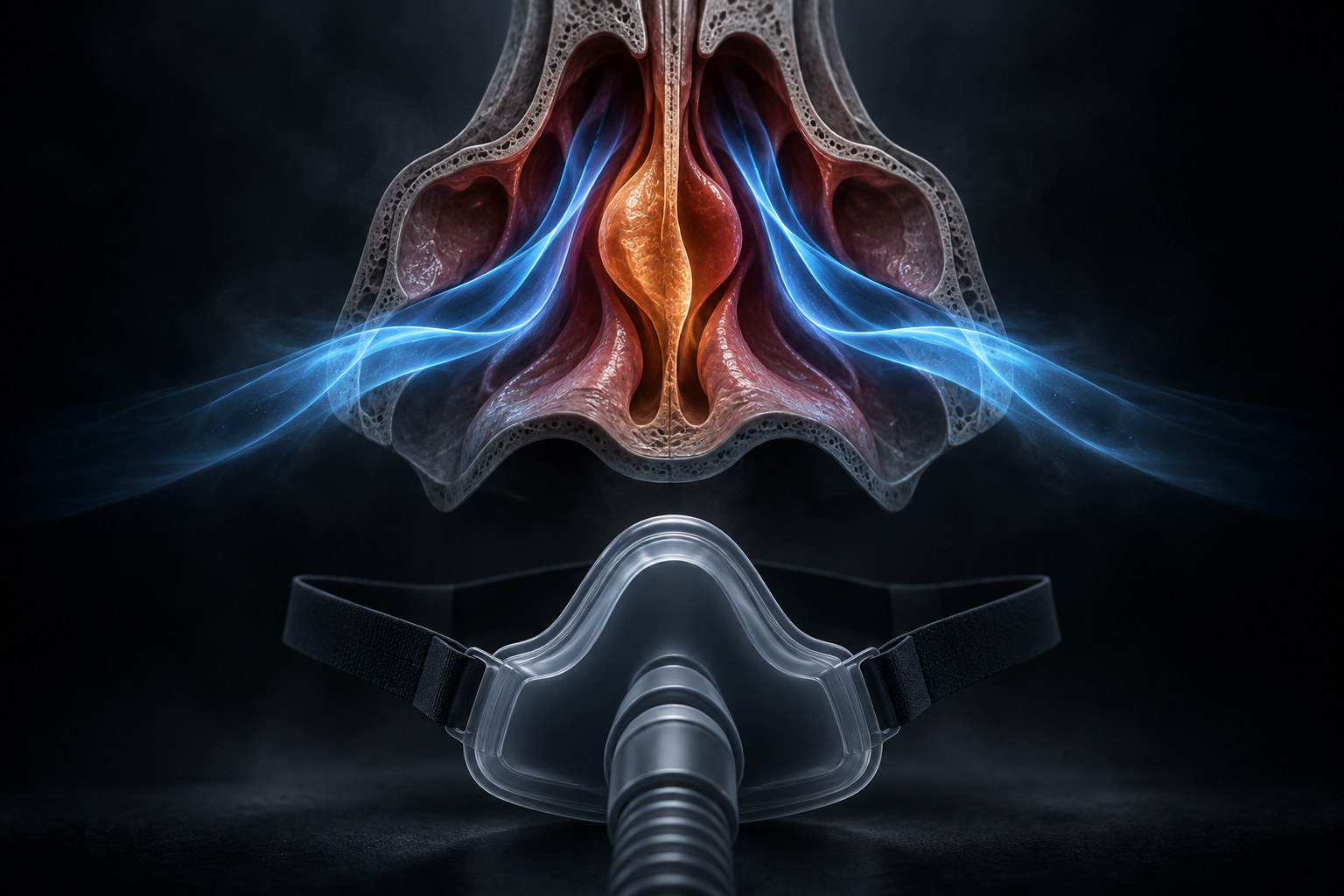
VA can service-connect obstructive sleep apnea as secondary to service-connected allergic rhinitis, and the Board of Veterans' Appeals did so in November 2022 when a private opinion on nasal congestion outweighed VA opinions that left part of the theory unanswered. The research is mixed: rhinitis and sleep apnea often occur together, but a 2018 meta-analysis found that among adults with sleep apnea, those with rhinitis did not have worse sleep-study results. That is why the opinion has to address your own sleep study, nasal history and the other causes of apnea, and why trouble tolerating a CPAP mask is a different question from what caused the apnea.
What the research says about rhinitis and sleep apnea
A 2018 meta-analysis of 44 studies found allergic rhinitis common among people with obstructive sleep apnea: about 35% of adults with sleep apnea had it. But adults with sleep apnea who had rhinitis did not differ from those without it in body mass index, neck size, the apnea-hypopnea index (the sleep-study count of breathing events) or daytime sleepiness scores. A systematic review of nasal obstruction found that most trials did not link nasal blockage to the apnea-hypopnea index. A review of nasal function and CPAP use found some links between nasal problems and CPAP adherence or pressure, with mixed results for nasal symptoms.
Read together, the research supports a narrower claim than "congestion causes apnea." It supports asking whether nasal disease contributed to apnea in your case, whether it made existing apnea worse, and whether it interferes with treatment. Those are three different questions.
What the Board did in a sleep apnea secondary to allergic rhinitis appeal
In A22023607 (November 21, 2022), the veteran had served in Southwest Asia and was service connected for allergic rhinitis and sinusitis. Records after service showed trouble breathing at night, snoring and waking three to four times a night, and he was later diagnosed with obstructive sleep apnea. Because of how the appeal reached the Board, it could consider only the evidence on file as of a March 2020 decision.
One VA examiner said the apnea was not related to service because it was not diagnosed in service. A second VA examiner said the medical literature does not show sleep apnea to be a complication of allergic rhinitis. A private physician said allergic rhinitis and sinusitis cause congestion in the upper airway and contribute to the development of sleep apnea. The Board noted that neither VA examiner addressed whether sinusitis could cause or contribute to sleep apnea, found the evidence in relative balance, resolved the doubt in the veteran's favor, and granted sleep apnea secondary to allergic rhinitis.
The grant rested on the benefit of the doubt and on gaps in the VA opinions, not on settled science. A claim that relies only on a general statement about congestion, against a VA opinion that addresses the full theory, may not come out the same way.
For context, Claim Raven's analysis of Board decisions counts 1,115 decided records under the single label sleep apnea: 38.2% favorable, 24.7% denied and 37.1% remanded, with service-connection and rating appeals mixed together. Among 131 sleep apnea denials with a classified reason, the most common was no nexus (60.3%). Across secondary claims, opinions the Board described as strong went with favorable outcomes in 94.1% of 2,973 condition records, against 1.7% of 4,496 where the opinion was weak. The figures come from appeals of already-disputed claims, mostly decided in 2024 and 2025, and they describe patterns rather than your chances.
Onset, worsening and mask tolerance are separate questions
Under 38 C.F.R. § 3.310, the link can be causation (rhinitis contributed to the apnea developing) or aggravation (rhinitis made existing apnea worse). For aggravation, the regulation's text asks for a baseline from medical evidence before the worsening, or the earliest evidence after it, and pays only the increase. If rhinitis symptoms got worse after your apnea was diagnosed, that chronology may support an aggravation question. It should not be rewritten as an onset story.
Trouble using a CPAP mask because of nasal blockage is not proof of what caused the apnea. It can still matter. In Spicer v. McDonough (2023), the Federal Circuit held that the compensation statute covers a condition that is worse because a service-connected disability interferes with treating it, not only one the disability directly caused. If rhinitis keeps you from using prescribed treatment and your apnea is less controlled as a result, ask the clinician to address that specifically, with the dates in your CPAP and nasal treatment records.
Weight is a common competing factor: the National Heart, Lung, and Blood Institute lists obesity among the causes of obstructive sleep apnea, along with age, airway anatomy, alcohol and smoking. If your theory runs through weight gain linked to another service-connected condition, that chain has its own legal test, covered in obesity as an intermediate step.
The sleep apnea rating today, and a bill that would change it
VA currently rates sleep apnea under Diagnostic Code 6847 in 38 C.F.R. § 4.97: 0% for a documented sleep breathing disorder without symptoms, 30% for persistent daytime hypersomnolence, 50% when a breathing assistance device such as CPAP is required, and 100% for chronic respiratory failure with carbon dioxide retention, cor pulmonale or a tracheostomy.
Section 108 of the Take Care of America's Veterans Act (H.R. 9237) would replace those levels for claims filed after it becomes law, with 50% only when treatment is ineffective or cannot be used because of other conditions. The bill text says the change could not reduce compensation already in effect. It is not law: the latest House action, on July 16, 2026, postponed further proceedings, and the Senate version, S. 4744, has been on the Senate calendar since June 11, 2026 (status checked September 23, 2026). The analysis of the Take Care of America's Veterans Act covers what the proposal would change. The sleep apnea condition guide and the allergic rhinitis guide cover the current rating rules for each condition.
Records for a sleep apnea secondary to rhinitis claim
| Record | Why it matters |
|---|---|
| The full diagnostic sleep-study report and the clinician's interpretation | Shows the type of apnea and its severity; keep the whole report, not one number |
| The rhinitis service-connection decision and treatment history | Establishes the primary condition and its course |
| Notes documenting congestion or nasal obstruction, with dates | Places nasal symptoms before or after the apnea diagnosis |
| CPAP prescription, mask changes and any compliance data | Shows treatment and any trouble using it |
| Records on weight, anatomy, alcohol, sedating medicines and other airway conditions | The opinion has to weigh them |
Questions for the clinician about rhinitis and sleep apnea
- What type of sleep apnea does the sleep study show, and how severe is it?
- In my history, is there evidence that nasal disease contributed to the apnea developing, or only to symptoms and treatment difficulty?
- If the apnea came first, is it worse today than it would be but for the rhinitis, and what earlier records show its baseline?
- Does my nasal condition interfere with CPAP use, and is my apnea less controlled because of it?
- How do weight, anatomy, age and other factors in my record affect your conclusion?
The guide to nexus letters for secondary conditions explains how to frame each question for a clinician, and the sleep apnea nexus letter page lists what an apnea opinion usually covers.
Sources and scope
Checked September 23, 2026: the current eCFR text of 38 C.F.R. §§ 3.310 and 4.97 (DC 6847); the Spicer opinion; the three linked reviews; the text and action history of H.R. 9237 and S. 4744 through the Library of Congress congress.gov data service; and the full text of Board decision A22023607, which binds only that appeal. Claim Raven sells the nexus readiness check offered with this article and has a commercial interest in its use.
 Insomnia Secondary to Tinnitus: VA Evidence and Rating
 Sleep Apnea Claim Denied: Separate Diagnosis, Connection, and Rating
 Sleep Apnea Secondary to Tinnitus: What VA and the Board Need