
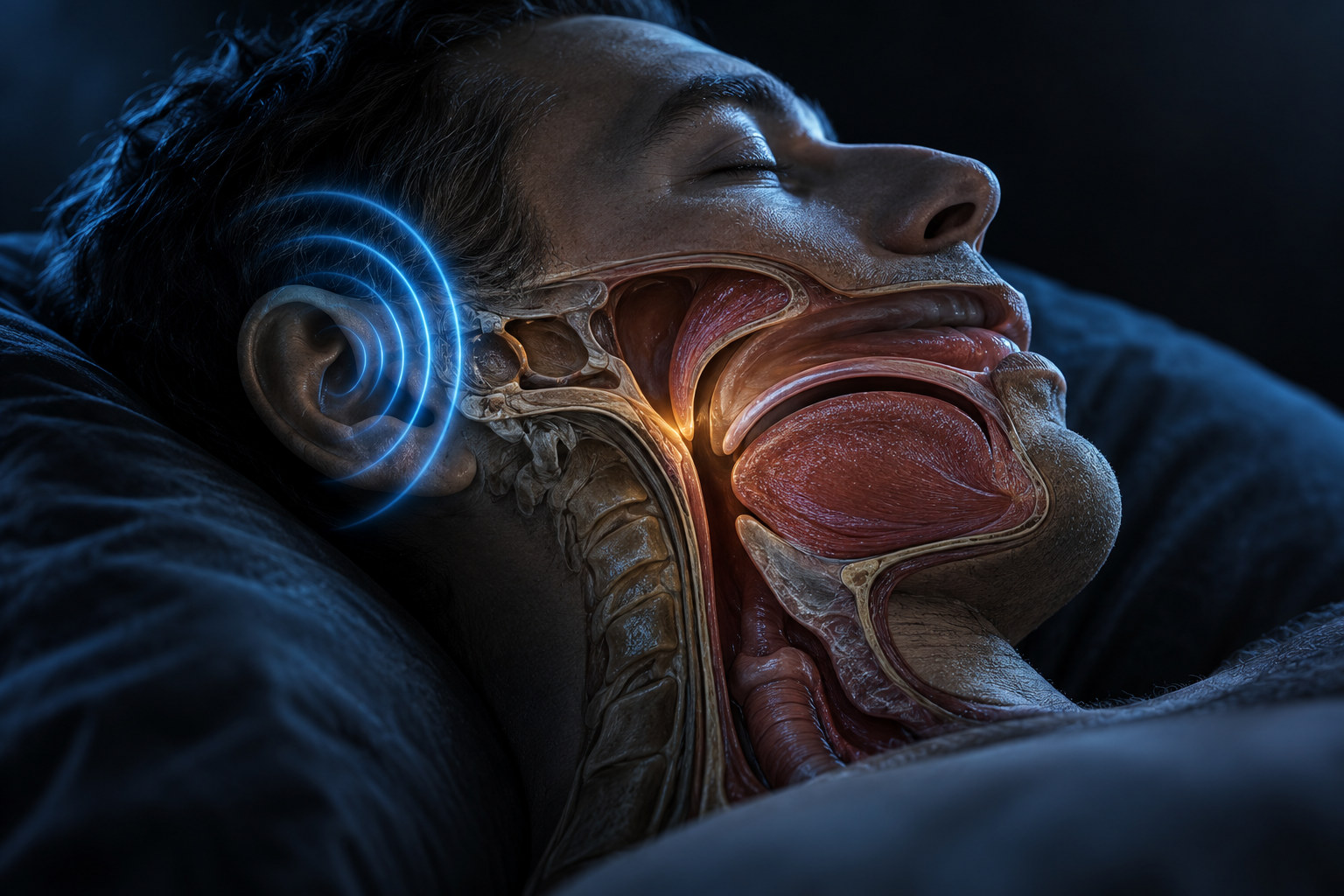
VA can grant sleep apnea secondary to tinnitus, and the Board of Veterans' Appeals has done so, but the medical case is harder than most secondary claims. Tinnitus does not block the airway, and the studies that link the two conditions show at most an association, often pointing the other way. The Board grant on record turned on a gap in VA's opinion: the examiner said tinnitus could not cause apnea but never addressed whether it made the apnea worse, and a private opinion did.
What the Board did with sleep apnea secondary to tinnitus
In A23033748 (November 29, 2023), the veteran had service-connected tinnitus and a 2010 sleep study showing severe obstructive sleep apnea. A March 2021 VA examiner acknowledged that constant tinnitus can impair sleep and cause daytime sleepiness, but concluded that tinnitus does not cause the anatomical changes in the airway that produce apnea. The examiner did not address aggravation, and the Board gave that opinion low probative value for that reason. A private physician, relying on the veteran's records, his statements and medical literature on tinnitus and sleep, concluded that the apnea was more likely than not caused or aggravated by the tinnitus. The Board gave that opinion great weight and granted service connection.
Two cautions keep this decision in proportion. First, the private opinion's summary of the literature, as the Board recounted it, leaned heavily on how often people with tinnitus report sleep problems, which is not the same as showing tinnitus causes airway obstruction. Second, the outcome turned on the VA examiner's failure to answer the aggravation question. A VA opinion that addresses both causation and aggravation with reasons would present a harder case.
For context, Claim Raven's analysis of Board decisions counts 1,115 decided records under the single label sleep apnea: 38.2% favorable, 24.7% denied and 37.1% remanded, with service-connection and rating appeals mixed together. Among 131 sleep apnea denials with a classified reason, no nexus was the most common (60.3%). Across secondary claims, opinions the Board described as strong went with favorable outcomes in 94.1% of 2,973 condition records, against 1.7% of 4,496 where the opinion was weak. Because these are appeals of claims already denied or disputed, mostly from 2024 to 2025, they describe patterns, not your odds. For a sleep apnea grant built on a different theory, see the case study of sleep apnea secondary to PTSD.
What the research shows about tinnitus and sleep apnea
The National Heart, Lung, and Blood Institute describes obstructive sleep apnea as repeated blockage of the upper airway during sleep, with risk factors such as body structure, age, obesity, smoking and alcohol. Poor sleep from ringing is a different problem from that airway mechanism.
Two recent studies looked for a link:
- A 2025 analysis of U.S. survey data found an association between a questionnaire-based sleep apnea risk score and self-reported tinnitus. It did not confirm apnea with sleep studies, and the authors concluded that sleep apnea is a risk factor for tinnitus, the opposite direction from this claim.
- A 2025 Korean national study found more tinnitus among people at high risk for sleep apnea, but after matching the groups on factors that cause tinnitus, the difference disappeared. The authors concluded that tinnitus was linked to the hearing loss that accompanies sleep apnea, not to sleep apnea itself.
Neither study shows that tinnitus causes or worsens sleep apnea. A clinician can still conclude, on your record, that a link is at least as likely as not, but the opinion has to explain the mechanism in your case rather than cite a general association.
Causation, aggravation and the sleep study
VA's evidence page says a secondary claim needs a current condition and a link to a service-connected disability, usually supported by medical records or an opinion. Under 38 C.F.R. § 3.310, that link can be causation or aggravation. If your apnea was diagnosed before tinnitus could have affected it, the claim is about aggravation. The regulation's text asks for a baseline from medical evidence before the worsening and pays only the increase above it. Since Spicer v. McDonough (2023), VA also cannot use that regulation to deny a claim where the apnea would be less severe but for the tinnitus.
Start with the diagnosis. Obstructive and central sleep apnea have different mechanisms, and only a sleep study and a clinician's interpretation establish which one you have. Bring the full report, not a summary line. If your real problem is that ringing keeps you from falling asleep, an insomnia claim may fit your facts better than an apnea theory.
Some apnea claims run through weight gain linked to a service-connected condition. That chain has its own legal test, explained in obesity as an intermediate step.
| Question | Record to find |
|---|---|
| What type of apnea was diagnosed, and how severe? | Full sleep-study report and the clinician's interpretation |
| When was tinnitus service connected, and when did apnea start? | Rating decision, earliest sleep complaints, sleep-study dates |
| Is the theory causation, aggravation, or both? | Treating clinician's notes; any existing opinions in full |
| What other factors were assessed? | Weight history, airway findings, alcohol and tobacco history, sedating medicines |
| If worsening is claimed, what was the earlier level? | Earlier and later sleep studies, CPAP settings and adherence data |
Questions for the clinician about tinnitus and sleep apnea
- Does the sleep study show obstructive apnea, central apnea, both, or something else?
- Is there a medically supported path from my tinnitus to my apnea, based on findings in my record rather than disturbed sleep alone?
- If the apnea came first, would it be less severe today but for the tinnitus, and what earlier evidence shows its baseline?
- Which other factors carry weight in my case, and why?
- Would a missing study or record change your conclusion?
A clinician may conclude the connection is not supportable. That answer is worth having before paying for a letter. The guide to nexus letters for secondary conditions explains how to frame both questions, and the sleep apnea nexus letter page lists what an apnea opinion usually covers.
The current ratings, and a bill that would change both
VA rates sleep apnea under Diagnostic Code 6847 in 38 C.F.R. § 4.97: 0%, 30% for persistent daytime hypersomnolence, 50% when a breathing device such as CPAP is required, and 100% for the most severe complications. Tinnitus is rated at a single 10% under Diagnostic Code 6260. Section 108 of the Take Care of America's Veterans Act (H.R. 9237) would change both for claims filed after it becomes law: sleep apnea would reach 50% only when treatment is ineffective or cannot be used because of other conditions, and tinnitus would lose a separate compensable rating except alongside otherwise noncompensable service-connected hearing loss. The bill says the changes could not reduce compensation already in effect. It is not law: the latest House action, on July 16, 2026, postponed further proceedings, and the Senate version, S. 4744, has been on the Senate calendar since June 11, 2026 (checked September 23, 2026). The sleep apnea condition guide and the tinnitus condition guide cover the current rules.
Sources and scope
Checked September 23, 2026: VA's evidence page; the current eCFR text of 38 C.F.R. §§ 3.310, 4.87 and 4.97; the Spicer opinion; NHLBI's sleep apnea causes page; the two linked studies; the text and action history of H.R. 9237 and S. 4744 through the congress.gov data service; and the full text of Board decision A23033748, which binds only that appeal. Claim Raven sells the nexus readiness check on this page; weigh this guide with that commercial interest in mind.
 Migraines Secondary to Tinnitus: What a VA Claim Needs
 Sleep Apnea Secondary to Rhinitis: What a VA Claim Needs
 Sleep Apnea Secondary to PTSD Granted: The Weight-Gain Chain Two VA Exams Missed