A denied claim was supposed to get another look. Then the correction itself needed correcting.
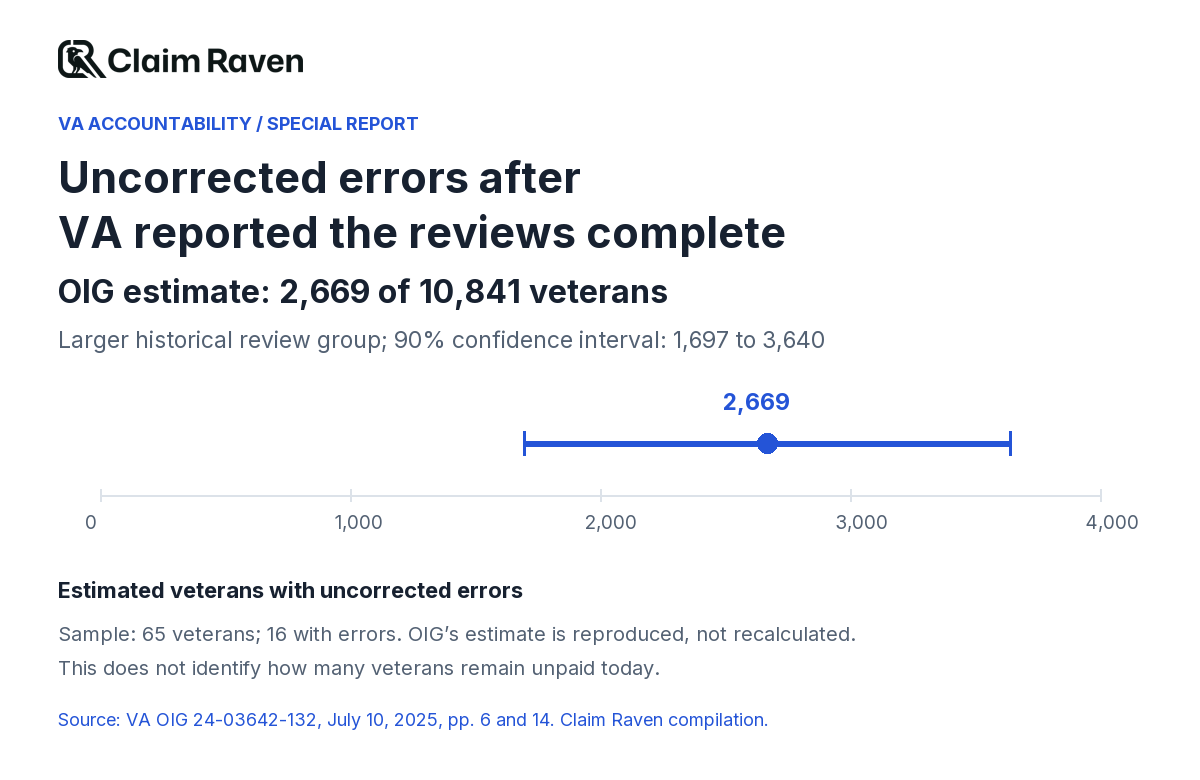
In 2024, VA told its Inspector General that it had reviewed old burn-pit denials and taken the required corrective action. The watchdog checked the work. In one group, it estimated that nearly 2,700 veterans still had claims with uncorrected processing errors.
A review can be marked complete while the work a veteran needed remains unfinished. OIG follow-up, pages 5-8
In its July 2025 report, OIG warned that affected veterans “could still be missing service-connected compensation benefits” to which they were entitled. OIG follow-up, page 8
I traced the original recommendations, VA's response and the follow-up records to answer a practical question: when VA says it has fixed a claims problem, what evidence shows the affected veterans actually received a proper review?
VA's original target was the end of 2022
In July 2022, the VA Office of Inspector General, or OIG, told the Veterans Benefits Administration to review two specified sets of denied claims completed from May 1, 2020 through May 1, 2021. VA was supposed to correct errors and certify that the reviews were complete.
One set involved conditions veterans had identified as related to burn pits. The other involved five respiratory conditions claimed by veterans who served where and when burn pits were used, even when they hadn't specifically raised exposure in their claim.
VA agreed to both recommendations and set the same target completion date: December 31, 2022. That date appears in VA's own response, attached to the original report. Original report, page 34
The closure requests came later. On May 29, 2024, VA asked OIG to close the first review recommendation. On August 12, 2024, it asked to close the second. The August request said staff had “taken corrective action on all claims identified,” according to OIG. VA supplied workbooks to support its completion requests. The watchdog tested that assurance against random samples of the reviewed claims. Follow-up, pages 5-6
The second review still found missing work
The larger recheck covered veterans with denied claims for bronchial asthma, chronic bronchitis, allergic rhinitis, sleep apnea or chronic obstructive pulmonary disease that VA had not identified as burn-pit claims.
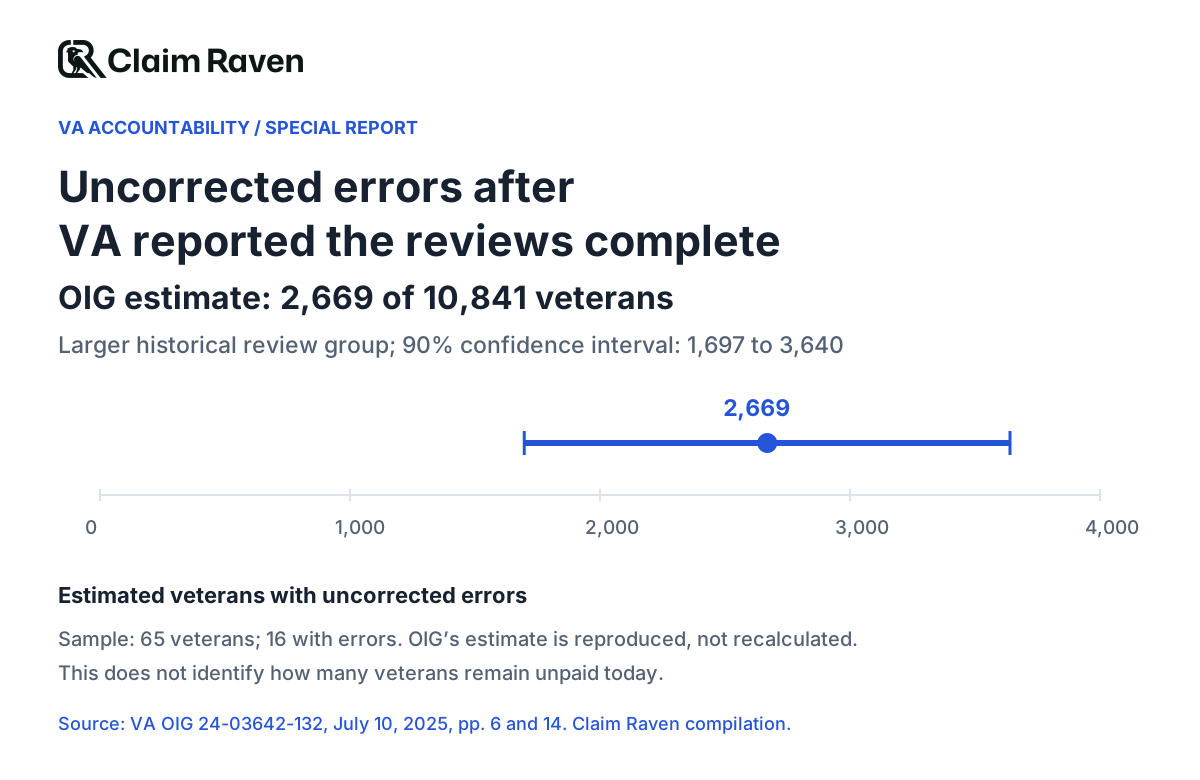
OIG reviewed a random sample of 65 veterans' claims from a population of 10,841. Sixteen sampled records had processing errors that VA had not identified and corrected. OIG projected that 2,669 veterans, or 25% of that population, had such errors. Its 90% confidence interval ranged from 1,697 to 3,640 veterans.
A separate sample of 55 from a population of 901 veterans with identified burn-pit claims projected 278 veterans with errors, or 31%. These are two distinct estimates, not an error rate for all VA claims. Follow-up, page 6 and statistical tables, pages 13-15
The missing work was medical evidence needed to make properly informed decisions. A second look is worth little if it leaves that gap in place. OIG estimated that 94% of the errors in each group could affect monetary benefits. That means veterans might have missed compensation. It does not establish that every claim should have been granted or tell us the total back pay owed.
One veteran did not specifically name burn-pit exposure
OIG described an Iraq veteran whose sleep-apnea claim was denied because VA found no direct connection to military service. The veteran had not submitted a statement linking the condition to burn pits.
The veteran was not expected to arrive with an inventory of every environmental hazard encountered in service. The policy quoted by OIG acknowledged that “Veterans generally will not possess knowledge” of all those hazards. Staff were supposed to consider exposure based on the service location, even when the veteran had not raised it. OIG said VA should have obtained a medical opinion addressing the possible connection.
VA agreed with OIG's analysis. The correction was still pending when the follow-up was prepared. This is an anonymous case documented by OIG, not a Claim Raven interview, and the report does not supply a later outcome. Follow-up, pages 7-8
VA had encountered this verification problem before
A separate August 2022 OIG audit found 47 of 179 claims with previously identified benefit errors had been erroneously marked corrected in VA's Quality Management System. OIG found staff could close errors without supervisory approval and that correction validation was inadequate. 2022 audit, pages 17-19
All six recommendations from that audit later closed, the last in September 2024. These were different claims and reviews. The record does not establish that the same system weakness caused the burn-pit failures. It does show why correction work needs independent verification. Recommendation record
The PACT Act did not make these errors disappear
The denials under review predated the PACT Act. The law subsequently expanded the conditions VA presumes are connected to qualifying toxic exposure, reducing the evidence eligible veterans need to establish that connection.
OIG checked the old decisions against the rules applicable during the original review period. It also explicitly said the errors found during the recheck would warrant correction under PACT Act criteria. Follow-up, page 3
Expanded eligibility therefore does not establish that these particular decisions were repaired. Nor should readers assume every condition discussed in the audit became presumptive: sleep apnea, for example, is not on VA's current burn-pit presumptive list. VA's PACT Act guidance
VA agreed to another review plan. The recommendations remain open.
In its April 30, 2025 response, VA agreed with OIG's findings and proposed a workgroup to plan and implement the corrective reviews. It said the group would develop workload plans, procedures, training and quality processes. The response left target completion dates to the workgroup. Years after the original deadline, VA was proposing another plan for completing the reviews.
OIG declined to close the two recommendations and said it would continue requesting quarterly progress updates. Follow-up, page 8 and VA response, pages 16-17
The two recommendations remained open in OIG's report to Congress covering October 2025 through March 2026. They were still open on the original report's public page when checked September 13, 2026. Five other recommendations from the original report are closed and implemented, including changes to guidance, examination requests and training. Report to Congress, page 58; current recommendation record
That leaves a specific accountability question more than three years after VA's original completion target: how many affected veterans have since received a properly developed decision and, where warranted, the benefits they were owed?
The records reviewed here do not answer that. Open recommendations show that the watchdog has not accepted completion. They do not prove that no further corrections occurred or that every veteran identified in the 2025 estimates remains unpaid today.
Veterans should not need to follow years of audit reports to find out whether a promised correction reached their claim.
VA should publish the accounting: how many decisions were properly reviewed, how many changed, what benefits were paid where warranted, and who checked the work. Until then, the public has a record of promised corrections and a failed recheck, but no complete picture of what those corrections ultimately delivered.
If you have an old denial
VA's current guidance says that if it previously denied a condition it now considers presumptive, you can submit a Supplemental Claim for another review. It also says you do not need to wait for VA to contact you. VA's guidance for previously denied claims
That guidance is separate from the specific corrective reviews examined here. This report cannot identify whether your claim was included or which review option fits your circumstances.
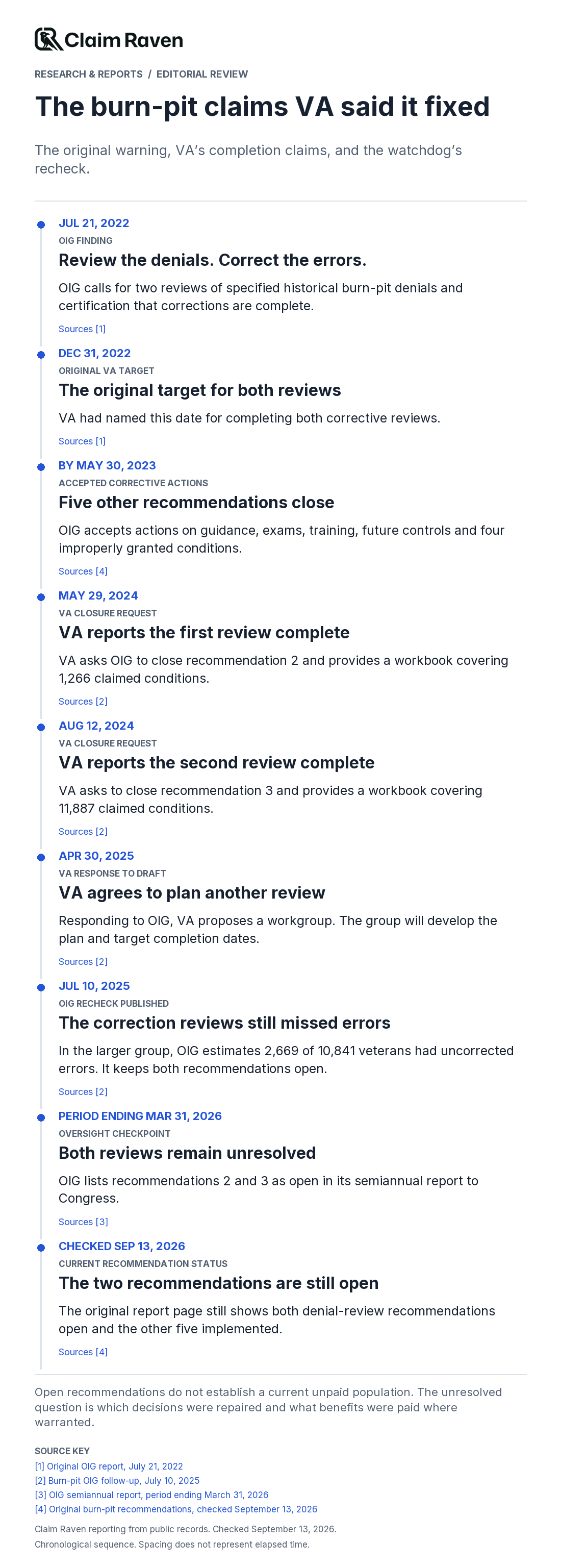
The correction timeline
Dates distinguish targets, submissions, publication and status checks.
JUL 21, 2022Review the denials. Correct the errors.
OIG calls for two reviews of specified historical burn-pit denials and certification that corrections are complete.
Original OIG report, July 21, 2022. Recommendations 2 and 3. Denials completed May 1, 2020 to May 1, 2021; not all VA claims.
DEC 31, 2022The original target for both reviews
VA had named this date for completing both corrective reviews.
Original OIG report, July 21, 2022. Printed p.34; PDF p.41. Original management target, not a statutory deadline or a completion event.
BY MAY 30, 2023Five other recommendations close
OIG accepts actions on guidance, exams, training, future controls and four improperly granted conditions.
Original burn-pit recommendations, checked September 13, 2026. Recommendations 1, 4, 5, 6, 7. Closures occurred December 22, 2022; March 21, 2023; May 30, 2023. The two denial-review recommendations remain separate.
MAY 29, 2024VA reports the first review complete
VA asks OIG to close recommendation 2 and provides a workbook covering 1,266 claimed conditions.
Burn-pit OIG follow-up, July 10, 2025. Printed pp.5-6. VA submission described by OIG; the original memo and workbook were not obtained. Conditions, not unique veterans.
AUG 12, 2024VA reports the second review complete
VA asks to close recommendation 3 and provides a workbook covering 11,887 claimed conditions.
Burn-pit OIG follow-up, July 10, 2025. Printed p.6. VA submission described by OIG; not independent verification. Conditions, not unique veterans.
APR 30, 2025VA agrees to plan another review
Responding to OIG, VA proposes a workgroup. The group will develop the plan and target completion dates.
Burn-pit OIG follow-up, July 10, 2025. Printed pp.16-17. Response predates publication of the July follow-up; no later completion date established.
JUL 10, 2025The correction reviews still missed errors
In the larger group, OIG estimates 2,669 of 10,841 veterans had uncorrected errors. It keeps both recommendations open.
Burn-pit OIG follow-up, July 10, 2025. Printed pp.6-8, 14. OIG estimate, not a current unpaid count. Sample: 65; 16 with errors. 90% count interval: 1,697-3,640. Separate smaller-population estimate is not added.
PERIOD ENDING MAR 31, 2026Both reviews remain unresolved
OIG lists recommendations 2 and 3 as open in its semiannual report to Congress.
OIG semiannual report, period ending March 31, 2026. Printed p.58; PDF p.64. Reporting-period endpoint, not a newly dated VA decision.
CHECKED SEP 13, 2026The two recommendations are still open
The original report page still shows both denial-review recommendations open and the other five implemented.
Original burn-pit recommendations, checked September 13, 2026. Recommendations 1-7. Open oversight status does not prove no corrections occurred or that every affected veteran remains unpaid.
Sources and scope
This is Claim Raven's reporting from published government records. The underlying findings and statistical estimates belong to OIG. We compared the 2022 report and VA response, the 2025 follow-up, a separate 2022 correction-verification audit, the 2026 report to Congress, current recommendation status and VA's current public guidance. The accompanying timeline and evidence workbook preserve dates, populations and source locations. The workbook reproduces OIG estimates and separately labels simple arithmetic checks. It does not contain individual claims or the original VA review workbooks, which we did not obtain.
Targeted public searches did not locate completed workgroup results showing corrected decisions or payment outcomes. Claim Raven has not contacted VA or OIG for this article. VA's response above is its published response to the watchdog.
Claim Raven operates a commercial VA claims preparation product. No customer records were used in this reporting.
Citation and reuse
Suggested citation: Landon. “VA said it fixed burn-pit denials. Its watchdog found the reviews still missed errors.” Claim Raven, September 13, 2026. Read the report.
The figures and statistical estimates are attributed to the government sources identified above. Credit OIG for the underlying findings and Claim Raven for this reporting and compilation.
 Burn Pit Presumptive Conditions: PACT Act List and Records
 The PACT Act Wave: How the VA Handled the Biggest Claims Surge in History
 Branch by Branch: A 12.6-Point Spread in BVA Grant Rates